What is advertising compliance software?
Advertising compliance software reviews and approves marketing communications before they publish.
It applies regulatory rule logic at submission, records the approval as evidence (the version approved, the principal who approved it, the date, and the source of every statistic), and monitors live content against its approved version afterwards. For US financial firms it supports FINRA Rule 2210 and SEC Rule 206(4)-1. It is distinct from communications archiving, which retains messages after they are sent.
That distinction is the single most expensive confusion in this category, so it's worth stating plainly at the top.
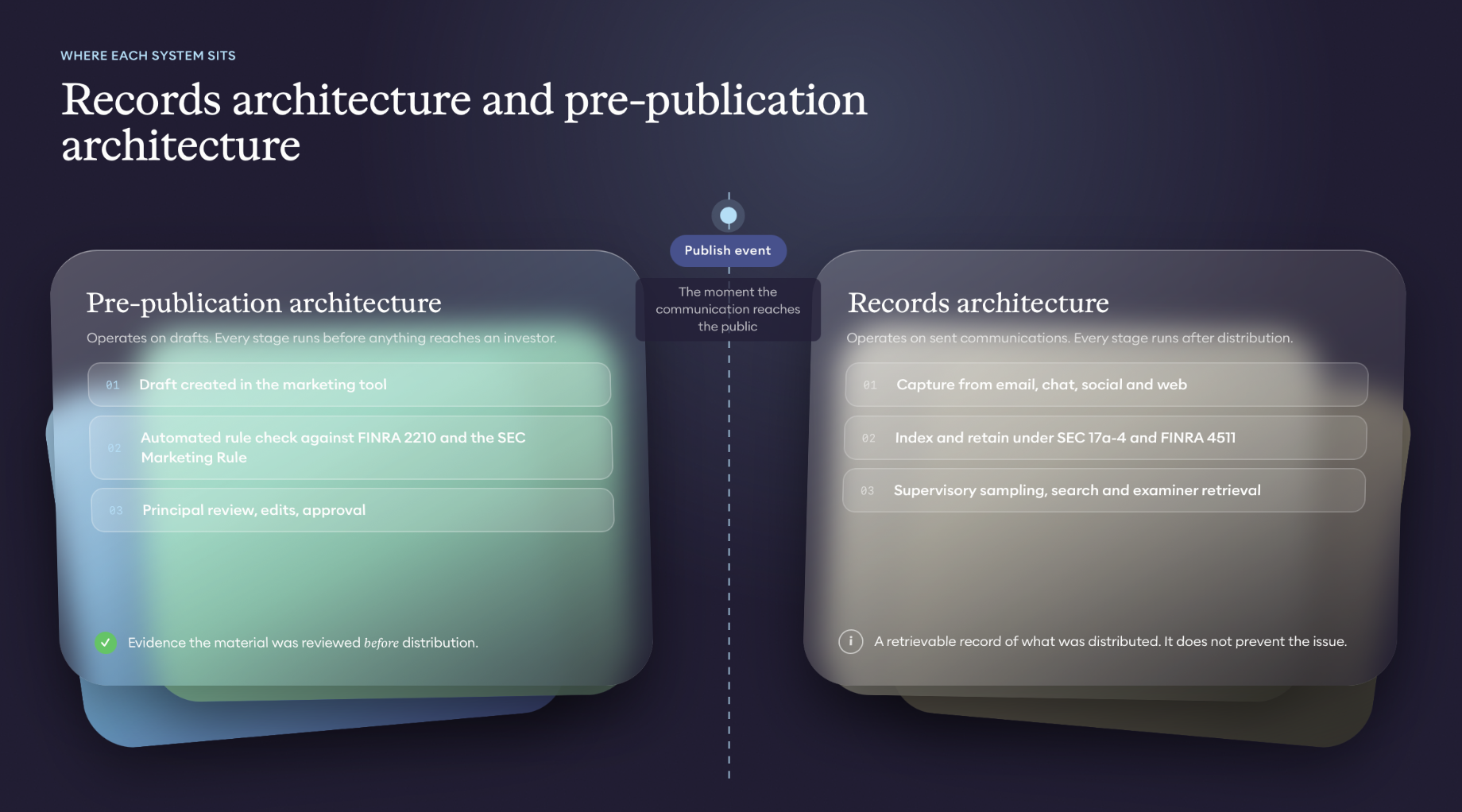
Most software that ranks for "advertising compliance software" cannot review an advertisement. It captures communications after they're sent, retains them for the required period, and surveils them for problems. That's a records product. It solves SEA Rule 17a-4. It does nothing for FINRA Rule 2210(b), which requires a registered principal to approve retail communications before the earlier of use or filing.
Two different obligations, two different architectures, two different budgets. Firms routinely buy the first and discover, usually during an exam, that they never bought the second.
The diagnostic: pick a retail communication your firm used nine months ago. Can you produce the approving principal's name, the exact version they approved, the approval date, and the source of every statistic in it, in under fifteen minutes? If not, you don't have an advertising compliance system. You have a folder.
Is FINRA changing the pre-approval rule for retail communications?
FINRA has proposed it, but the rule has not changed. Regulatory Notice 26-14, published 9 July 2026, proposes replacing mandatory registered-principal pre-approval of retail communications with risk-based supervisory standards. Comments close 11 September 2026. The proposal has not been filed with the SEC. Principal pre-approval remains mandatory today.
RN 26-14 also proposes eliminating the static-versus-interactive distinction that has governed social media since 2010, accommodating AI-generated communications inside the risk framework rather than pre-approving every output, and replacing several prescriptive disclosure requirements with a "fair and balanced" standard aligned to the investment adviser rules.
Read casually, that sounds like less compliance work. Read properly, it's the opposite.
Mandatory pre-approval is a blunt instrument, but it's a cheap one to evidence. Every retail communication has a principal's name on it. Done. A risk-based standard removes the blanket rule and replaces it with a burden of proof: you now have to demonstrate that your framework identified which communications warranted review, applied the right level of scrutiny to each, and did so consistently. A firm with a spreadsheet can't show that. A firm with a system can.
It's the same trade the SEC made in the Marketing Rule when it dropped the old advertising prohibitions in favour of principles plus substantiation. Principles-based regimes are easier to comply with and far harder to prove you complied with. The proof is the product.
Why do financial firms need advertising compliance software now? {#why-now}
Three forces converged, and the third one is being widely misread.
Filed volume is large, and unfiled volume is far larger
FINRA's economic analysis in RN 26-14 covers filings from 1 January 2023 to 31 December 2025. Members filed 4,501 retail communications before first use and 172,898 after first use in that window, across 593 firms. Separately, FINRA reviewed 150,295 investment company communication filings and found roughly 10% of them non-compliant. That's 14,479 pieces of marketing a regulated firm's internal process passed and FINRA's review didn't.
The filed volume is also the small part. Filing obligations catch a defined set of retail communications. Everything else, which for most fintechs is nearly everything, gets reviewed internally and never filed. The internal number is an order of magnitude larger and entirely invisible in the published statistics.
The regulator got faster and internal review didn't
FINRA's turnaround improved sharply over the same period. Average review completion for pre-use filings went from 40 business days in 2023, to 29 in 2024, to 17 in 2025. The regulator roughly doubled its speed in two years. Most firms' internal review didn't move. When the external clock beats the internal one, your own process is the constraint on go-to-market, and everyone in the building knows it.
Enforcement moved rather than disappeared
This is where most firms are reading the map wrong.
The SEC's off-channel communications sweep, which collected more than $2bn from over 100 firms, effectively stopped. The last wave was 13 January 2025: twelve firms, $63.1m. SEC enforcement overall fell to roughly 303 standalone actions in FY2025. The CFPB cut headcount from around 1,700 to 1,300, closed about 40% of pending investigations, and dismissed nineteen cases.
None of which means the obligations went anywhere.
FINRA has stated explicitly that it will keep examining member firms for recordkeeping compliance on a risk-focused basis, which relocates that exposure from a federal sweep into your regular exam cycle. And on 19 December 2025, New York signed the FAIR Business Practices Act into law, effective February 2026. It adds "unfair" and "abusive" to what had been a deception-only state standard, using definitions borrowed directly from Dodd-Frank, removes the judicial limitation that confined the Attorney General to consumer-oriented conduct, and extends coverage to businesses, not only consumers.
The federal enforcer stepped back and the largest financial state stepped forward with a broader statute. A firm that read the 2025 headlines as permission to relax has widened its exposure while narrowing its attention.
What is the difference between advertising compliance software and communications archiving?
Archiving captures and retains communications after they are sent, satisfying SEA Rule 17a-4 and Advisers Act Rule 204-2. Advertising compliance software reviews and approves marketing before it publishes, satisfying FINRA Rule 2210(b) and supporting SEC Rule 206(4)-1. Most firms above mid-size need both. Neither substitutes for the other, and they share almost no infrastructure.
This is worth being blunt about, because the search results actively mislead.
Search "SEC marketing rule compliance software" and the results include Smarsh, Global Relay, and Proofpoint. All three are serious companies with excellent products. None of them reviews marketing before it publishes. Their product navigations run Capture, Archive, Surveillance, Discovery, Supervision. Proofpoint's Patrol handles social media remediation, which is post-hoc and easy to mistake for pre-publication review. There's no principal approval workflow, no submission gate, no content standards check in any of them, because that isn't what they were built to do.
They rank because they have enormous domain authority and they've written good explainers about the rule. A buyer searching a pre-publication question lands on an archiving pitch, and unless they already know the distinction, they don't find out until implementation.
The two architectures answer different questions. A records and surveillance system exists to answer "what did we send, and can we retrieve it". It serves SEA 17a-4 and Advisers Act 204-2, it operates after the fact, and the thing it stores is the communication. When it fails, it fails as a retention gap or off-channel leakage.
A pre-publication review system exists to answer "should this go out, and who said so". It serves FINRA 2210(b) and (d) and supports SEC 206(4)-1, it operates before first use, and the thing it stores is the approval decision. When it fails, unapproved content goes live, or approved content turns out to be unprovable.
Smarsh, Global Relay and Proofpoint sit firmly in the first camp. Purpose-built advertising review platforms sit in the second. If your evaluation shortlist contains vendors from both columns scored against the same criteria, the criteria are wrong. For the equivalent split under UK rules, see our guide to what a defensible approval record actually contains.
What does FINRA Rule 2210 require from an advertising review system?
Four things: automatic categorisation against the 25-in-30 retail threshold, principal approval bound to an immutable version, a record containing all five elements of Rule 2210(b)(4), and enforcement of the filing calendar. Retention is three years from date of last use, the first two years in an easily accessible place, per SEA Rule 17a-4(b).
Most content on Rule 2210 is checklist-shaped. It tells you what the rule says. Very little of it translates the rule into what your software has to do, which is the question you're actually trying to answer. So, specifically.
Categorisation has to be automatic, because the threshold is a rolling count
Rule 2210(a) splits communications three ways. Correspondence reaches 25 or fewer retail investors in any 30 calendar-day period. Retail communications reach more than 25. Institutional communications go only to institutional investors.
That 25-in-30 threshold is a rolling count, and the category determines the supervisory obligation. A system that makes a human classify each piece will get it wrong at volume, and the direction of the error is predictable: correspondence creeps into retail territory as distribution widens and nobody recounts.
Principal approval must bind to a version, not a document
Rule 2210(b)(1) requires an appropriately qualified registered principal to approve each retail communication before the earlier of use or filing. If your system records "approved" against a file someone can then edit, you've recorded nothing. The approval has to attach to an immutable version, and the live asset has to be traceable back to it.
The record has a defined content list, and most systems capture half of it
Rule 2210(b)(4) and SEA Rule 17a-4(b) together require you to retain:
- The communication itself
- The dates of first and last use
- The name and title of the approving principal
- The approval date
- The source of any statistical table, chart, graph, or other illustration
Ask a vendor to demonstrate all five on a real record. Date of last use and source-of-statistics are the two usually missing, and they're the two that make an audit painful, because reconstructing them a year later means asking people what they remember.
The filing calendar is a routing rule, so it belongs in software
Some communications file ten business days before first use. That covers new member firms for a year from their membership effective date, across all retail communications in public media, plus registered investment company retail communications carrying performance rankings not generally published, security futures, registered CMOs, and registered derivatives.
Options communications are the outlier: ten calendar days rather than business days, and you must await staff comment before running them.
Others file within ten business days after first use. That covers retail communications promoting a specific registered investment company or fund family, public direct participation programs, and filmed versions of drafts already filed.
And a large category is excluded entirely: institutional communications, correspondence, prospectuses and SEC-filed offering documents, and previously filed material used without material change.
Nobody holds that correctly in their head under deadline.
What does the SEC Marketing Rule require for RIA advertising?
Advisers Act Rule 206(4)-1 turns on evidence. An adviser may not include a material statement of fact it lacks a reasonable basis for believing it can substantiate on demand by the Commission. Testimonials and endorsements require clear and prominent disclosure, adviser oversight, and a written promoter agreement. Gross performance may not be shown without net.
Where 2210 largely governs process and content standards, the Marketing Rule is a documentation obligation dressed as a content rule. The evidence has to be captured at the moment of drafting, when the writer knows where the number came from, not reconstructed under examination.
The operational surface:
- Testimonials and endorsements need clear and prominent disclosure of client versus non-client status and whether the promoter is compensated, adviser oversight, and a written agreement (with exceptions for affiliates and de minimis compensation at or below $1,000 in twelve months). Disqualified persons can't be compensated promoters.
- Performance can't be shown gross without net. Prescribed time periods apply in most circumstances. All portfolios with substantially similar objectives must be included. Hypothetical performance requires policies ensuring relevance to the intended audience.
What SEC examiners are actually finding
The staff has been active. A 19 March 2025 FAQ provides relief for gross-only extracted performance and portfolio characteristics, subject to conditions including equal-prominence presentation of total-portfolio gross and net. Two further FAQs landed on 15 January 2026, covering model fees and disqualification arising from SRO final orders.
An EXAMS Risk Alert on 16 December 2025 set out the deficiencies examiners are finding:
- Disclosure hyperlinked rather than presented in-text
- Missing promoter compensation and conflict disclosure
- Compensating ineligible persons
- Absent written promoter agreements
- Inadequate diligence on third-party rating methodology
- Ratings cited without dates
That list is instructive, because every item on it is a check a system can run at submission. Hyperlinked-instead-of-in-text disclosure is detectable. A missing promoter agreement is a required field. A rating cited without its date and methodology is a validation failure. These aren't judgement calls; they're the mechanical checks that eat reviewer time and get missed anyway.
For calibration rather than alarm: three Marketing Rule sweeps between 2023 and 2024 charged 23 advisers for a combined $2.29m, and 2025 produced one-off proceedings rather than a sweep. The penalties aren't what should motivate the spend. The exam findings are.
How do you know when you need advertising compliance software?
Seven signals. Three or more and the payback period is short.
- You can't produce the approving principal, the approved version, and the source of every statistic for a communication from last year inside fifteen minutes.
- Marketing distribution has widened and nobody is recounting against the 25-in-30 threshold.
- A registered principal spends more than a day a week on mechanical checks (disclosure presence, risk warning wording, performance net-of-fees) rather than judgement.
- First-pass approval sits below 70%, which means the entry standard is unenforced and reviewers are doing submitters' work.
- Influencer, affiliate, or partner content is going out without documented pre-approval. FINRA's 2026 Annual Regulatory Oversight Report names this explicitly: failure to review and approve influencer content before posting, and failure to retain it afterwards.
- You're deploying AI-generated customer-facing content or a chatbot without a supervision and retention path. Same report: firms must ensure AI-generated communications comply, that chatbot interactions are supervised and retained, and that AI product marketing describes the technology accurately and balances benefits against risks.
- Your paid social is getting rejected and nobody can explain the pattern. (Our breakdown of why compliant ads still get disapproved covers the common causes.)
On BLS data, the mean annual wage for compliance officers was $88,400 in May 2025. Applying the published 30.1% benefits load from the Employment Cost Index puts a loaded hire near $126,000. Platform cost for a mid-market firm sits well below that. The arithmetic isn't the hard part. The hard part is that the hire feels safer than the system, right up until the exam.
How should you evaluate advertising compliance software?
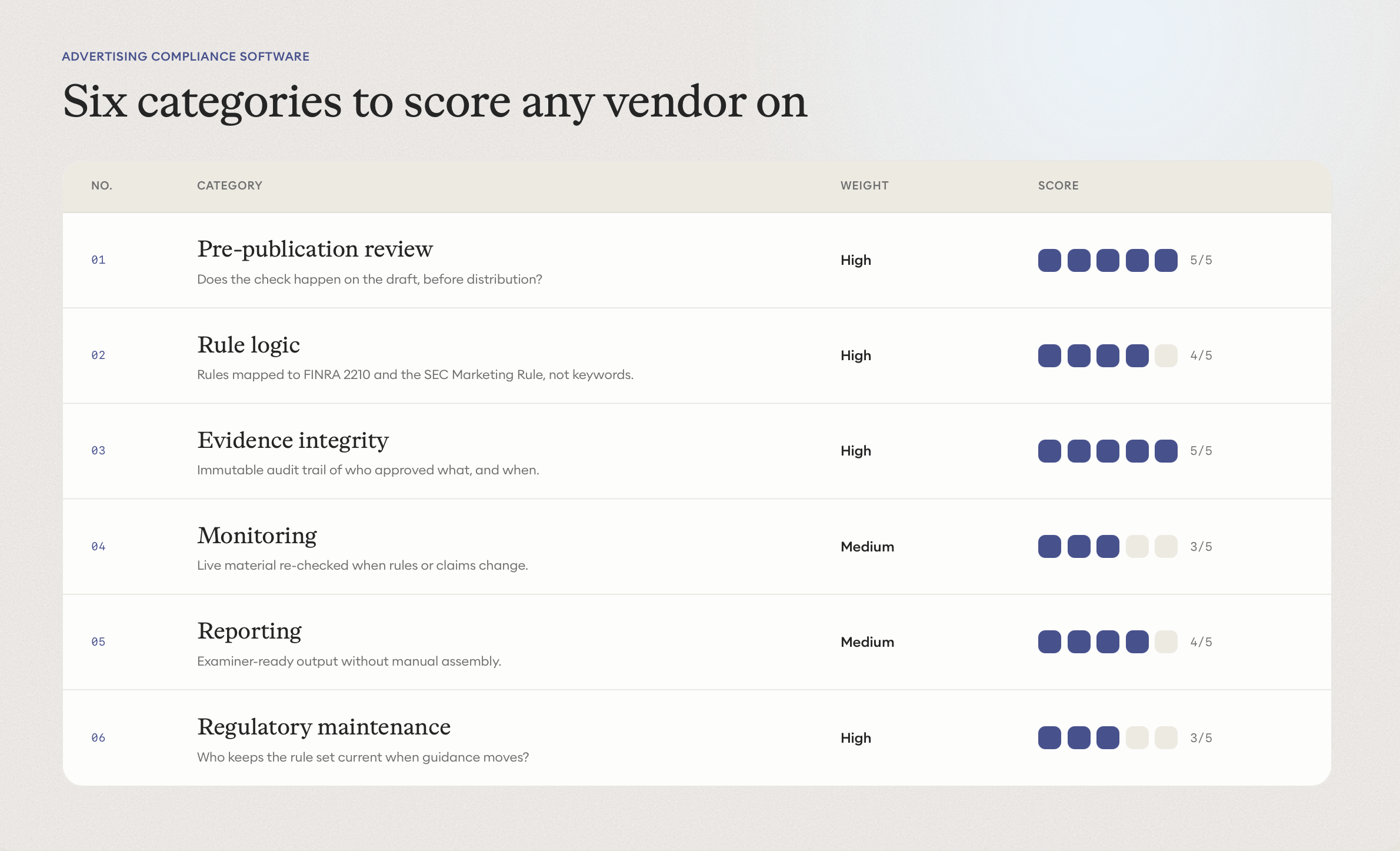
Six categories. Score every vendor on all of them. The first two will eliminate most of your shortlist.
1. Does it review content before publication?
Before anything else, confirm the product reviews content before it publishes. Ask to see a submission enter the system, fail a check, get fixed, and receive principal approval. If the demo goes straight to a dashboard of things already sent, you're looking at a records product.
Red flag: the vendor's product navigation reads Capture, Archive, Surveillance. Excellent words about a different problem.
2. Does it apply rule logic at submission, or just route work faster?
Ask: can you make evidence links and substantiation mandatory fields? Does it validate the 25-in-30 categorisation automatically? Does it check performance presentation for net alongside gross? Can you build product-specific checklists so a crypto promotion, a lending offer, and a fund fact sheet each carry different required elements? Does it detect a testimonial and demand the promoter agreement and compensation disclosure?
Why it matters: automation in regulated review doesn't begin at full autonomy. A credible early benchmark is 20 to 30% silent approvals inside controlled workflows, and that only works when submissions are structured enough for rules to evaluate them. Unstructured in, queue bloat out. Our copy checker breakdown walks through what first-pass automation can and can't catch.
3. Can it produce a complete approval record in minutes?
Ask: is approval bound to an immutable version, or to a document that can subsequently change? Are user IDs recorded rather than display names? Can a reviewer edit their approval rationale after the fact? Does the record carry all five 2210(b)(4) elements? Can you export a single promotion's full file for an examiner without assembling it by hand?
4. Does it monitor live content, or only submissions?
Approved content drifts. A partner edits a landing page. An affiliate refreshes copy. A paid team tweaks an ad mid-flight. Six months on, the page under review is frequently not the page that was approved, and the only party who knows is whoever complains.
Monitoring also produces the strongest evidence in the other direction: proof that the approved version was the version that ran. This is a genuine capability split rather than a checkbox. Some well-funded platforms in this category have no live-channel monitoring at all. See our guide to third-party and affiliate oversight.
5. Does the reporting change behaviour?
Can you see first-pass approval rate by product, channel, and team? Rejection reasons grouped by category rather than buried in comment threads? Time-to-approval trends?
The gap between a 45% first-pass rate and an 85% one is almost never reviewer quality. It's feedback loops. If you can't tell your paid social team the three things they get wrong every time, you'll keep paying a principal to catch them.
6. Who maintains the rule logic when the regulator moves?
Ask: does the system encode 2210's content standards and filing triggers natively? Does it handle 206(4)-1's testimonial conditions and performance requirements? Who updates it when RN 26-14 lands, and how fast? Is there a published record of the vendor shipping changes in response to specific regulatory events?
A generic platform asks you to upload your rules and reason about them. A financial-services platform has them built in and moves when the regulator moves. The difference shows up as a six-week internal project you didn't plan for.
Should you buy advertising compliance software, build it, or extend Jira? {#buy-build-or-extend}
Extend Jira, Asana, Workfront, or Monday. Cheap and fast, with a low and hard ceiling: custom fields aren't rule logic, ticket comments aren't evidence, and a status change isn't a principal approval. It holds below roughly 100 communications a month with stable products. It fails at examination, specifically on version-bound approval and source-of-statistics. We've written separately on where review actually belongs in the stack.
Build in-house. Attractive when engineering capacity is available. The cost isn't the build, it's the regulatory update tax. RN 26-14 alone, if adopted, is a re-architecture of the approval model rather than a configuration change. Every FAQ, every risk alert, every rule amendment becomes a sprint, forever, and the person who wrote it leaves.
Buy purpose-built. Higher line item, and rule maintenance sits with the vendor. Time to value runs weeks rather than quarters. The real argument for buying isn't cost, it's that defensibility is designed in rather than retrofitted, and retrofitting evidence integrity into a system that didn't start with it is close to a rewrite.
What results should advertising compliance software deliver? {#what-results-to-expect}
Median time to first approval is the number your growth team feels. On a manual process or a repurposed project management tool it runs three to five business days. On a dedicated platform it runs under four hours.
First-pass approval rate is the number that tells you whether your entry standard is real. Manual environments sit between 40 and 60%. Mature platform implementations clear 80%.
Post-publication monitoring is where the hours hide. Done by hand it absorbs 30 to 40 hours a month. Automated, it costs five to ten.
Assembling the audit file for a single communication takes days manually and minutes on a platform, and that one is what matters at examination rather than in the weekly stand-up.
The two softer measures move alongside them. Principal time shifts from mechanical checks, which is where most of it goes today, to exception handling. And submitter satisfaction moves from reliably negative to something you can actually measure.
These are operating figures from mature implementations, not vendor promises. Our case breakdown on collapsing a 60-day review cycle to six shows how the first row actually moves.
"We weren't trying to remove compliance. We were trying to stop it being the reason a campaign missed its window. Once the system did the mechanical checks, the principal spent their time on the calls that actually needed a person."
What are the main objections to buying advertising compliance software? {#objections}
"We already have Smarsh. Why do we need another compliance tool?"
Because Smarsh answers "what did we send and can we retrieve it" and 2210(b) asks "who approved this before it went out, and against which version". Your archive isn't a control on publication; it's a record of what escaped. Both are necessary above a certain size, neither substitutes for the other, and the infrastructure overlap is close to zero.
"FINRA is about to scrap principal pre-approval anyway, so why invest now?"
The proposal replaces a blanket rule with a risk-based standard. It doesn't remove the obligation; it converts an easy-to-evidence requirement into a hard-to-evidence one. Under mandatory pre-approval you show a name. Under a risk-based framework you show that your framework worked, consistently, across everything you published. Firms that already have a system will find that straightforward. Firms with a spreadsheet will find it's the harder regime, and they'll find out during an exam. And RN 26-14 is at comment stage, so today's rule is today's rule.
"Enforcement is down. The CFPB has been gutted, the SEC sweep ended."
Federal activity is down and the obligations are unchanged. FINRA has said it will keep examining member firms for recordkeeping on a risk-focused basis, so that exposure moved into your normal exam rather than disappearing. And New York's FAIR Business Practices Act took effect in February 2026 with unfair and abusive standards imported wholesale from Dodd-Frank, the consumer-oriented limitation removed, and coverage extended to businesses. Enforcement didn't decline so much as change address, and the new address has a broader statute.
"Our team won't trust AI checks on regulated content."
They shouldn't, initially. Run it in shadow mode. Let the system produce a recommendation alongside the human decision and compare them across a few hundred reviews. Trust follows demonstrated agreement, not a pitch. Any vendor who can't run in shadow first is skipping the part of adoption that determines whether it works.
"Our marketing isn't filed with FINRA, so most of this doesn't apply."
Filing obligations cover a narrow slice. The content standards in 2210(d), the principal approval requirement in 2210(b), and the recordkeeping requirement in 2210(b)(4) apply to retail communications whether or not they're filed. Unfiled doesn't mean unregulated, and the unfiled volume is where nearly all the risk sits, precisely because nobody outside the firm ever looks at it.
How does UK financial promotions compliance differ from FINRA and SEC rules?
The standards are close; the approval mechanics aren't. The FCA attaches approval permission to the firm under s21 FSMA. FINRA attaches it to an individually registered principal. The SEC Marketing Rule permits client testimonials subject to disclosure; UK firms typically treat them as off-limits. And FINRA imposes filing lead times that have no FCA equivalent.
The regimes rhyme, and the places they diverge are the places that cause damage.
What transfers. The core standard is portable. The FCA requires communications to be fair, clear, and not misleading; FINRA requires them to be fair and balanced with a sound basis for evaluation. Both demand risk and benefit be presented with comparable prominence. Both require substantiation. A UK firm with a mature financial promotions operating model already has most of the muscle: the tiering, the evidence discipline, the version control. Our UK category guide covers that side in full.
What doesn't. Three things catch UK firms out.
Approval is a person with a licence, not a firm permission. The UK s21 approver regime attaches permission to the firm. FINRA attaches it to an appropriately qualified registered principal, an individual holding the right registration. Your existing approver can't sign off US retail communications by virtue of the UK role.
Testimonials flip. The SEC Marketing Rule permits client testimonials subject to disclosure, oversight, and a written promoter agreement. UK firms accustomed to treating testimonials as effectively off-limits arrive in the US, discover they're allowed, and use them without the disclosure architecture the rule requires. It's one of the most commonly cited exam deficiencies.
Filing has a clock the UK doesn't have. There's no FCA analogue to the ten-business-day pre-filing window, and no UK equivalent of awaiting staff comment before running an options communication. New member firms in particular need to plan campaign calendars around a lead time that doesn't exist in their home market.
The practical implication. Run one process with jurisdiction as an attribute of the asset, not two processes in parallel. The same creative should carry different required elements, route to a different approver, and follow a different filing path, without forking the record. Firms that stand up a separate US process end up with two evidence standards, and the weaker one sets the firm's actual defensibility.
Advertising compliance software FAQ
What is the difference between advertising compliance software and communications archiving?Archiving captures and retains communications after they're sent, satisfying SEA Rule 17a-4 and Advisers Act Rule 204-2. Advertising compliance software reviews and approves marketing before it publishes, satisfying FINRA Rule 2210(b) and supporting SEC Rule 206(4)-1. Most firms above mid-size need both. Neither replaces the other.
Does FINRA Rule 2210 require software, or is manual review acceptable?The rule requires the outcome, not a particular tool. Manual review is acceptable and workable at low volume with a stable product set. It breaks at scale on three things: the rolling 25-in-30 categorisation count, binding approval to an immutable version, and capturing source-of-statistics at the point of drafting. Those are the failures that show up at examination.
How long does advertising compliance software take to implement?Four to six weeks for a firm with a defined approval workflow. Eight to twelve for multi-entity or multi-jurisdiction environments. The variable is almost never technical. It's internal agreement on what counts as substantiated, which products are high risk, and who is the approver of record.
What must a FINRA-compliant approval record contain?Five elements: the communication itself, the dates of first and last use, the name and title of the approving principal, the approval date, and the source of any statistical table, chart, graph, or illustration. Retain for three years from date of last use, with the first two years in an easily accessible place.
Will FINRA's proposed rule change remove the need for this software?The opposite is more likely. Regulatory Notice 26-14 proposes replacing mandatory principal pre-approval with risk-based supervisory standards. Blanket pre-approval is evidenced by a name on a record. A risk-based framework must be evidenced by demonstrating consistent, appropriate application across everything published, which is substantially harder without a system. The proposal is at comment stage until 11 September 2026 and hasn't been filed with the SEC.
Can advertising compliance software handle influencer and affiliate content?It should, and this is where to press hardest in a demo. FINRA's 2026 Annual Regulatory Oversight Report specifically names failure to review and approve influencer content before posting, and failure to retain it. Ask whether the platform pre-approves third-party content and whether it monitors those channels afterwards. They're different capabilities and several vendors have only one.
How do you measure return on advertising compliance software?Three inputs: principal hours returned to judgement work (multiply by loaded cost, near $126,000 on 2025 BLS wage data plus the published benefits load), compliance hires deferred, and campaign cycle time recovered. Most firms reach break-even on the first two alone inside a year. The third is the one your revenue team will care about.
Does advertising compliance software work for both broker-dealers and RIAs?It should handle both, because the obligations differ. Broker-dealers need FINRA 2210 categorisation, principal approval, and filing logic. RIAs need SEC Marketing Rule substantiation capture, testimonial disclosure validation, and performance presentation checks. Dually registered firms need both applied to the same asset without duplicating the record.
Adclear's point of view
Software that enforces a bad standard faster produces bad standards at scale. Before tooling anything, write down what substantiation means at your firm, which products carry which required elements, and who is the approver of record for each. That document is the actual product. The platform enforces it.
Adclear is pre-publication marketing compliance software for regulated financial firms. It applies rule logic at submission rather than at review, binds approval to an immutable version with the full evidence record attached, routes by risk tier, and monitors live content against its approved version after publication. It was built for firms operating under the FCA's financial promotions regime and extends to FINRA and SEC requirements for firms working across both markets, which is a different starting point from tools built as records systems with a review feature added later.
We're direct about the limits. It can't fix a governance model that hasn't been decided. It can make a decided one fast, consistent, and provable.
Next step
Two questions will tell you more than an RFP.
What's your first-pass approval rate, split by channel?
How long would it take to produce a complete approval record, all five elements, for a communication from last year?
Book a 30-minute walkthrough. We run the six-category framework against your current process, show where automation is safe to start, and say plainly where a system is the wrong answer.
Adclear is pre-publication marketing compliance software for regulated financial firms. This article is general information, not legal or compliance advice. Rules change; verify current requirements at finra.org and sec.gov.
Once you're booked in, we'll send you a free playbook on Financial promotions compliance for FinTechs.