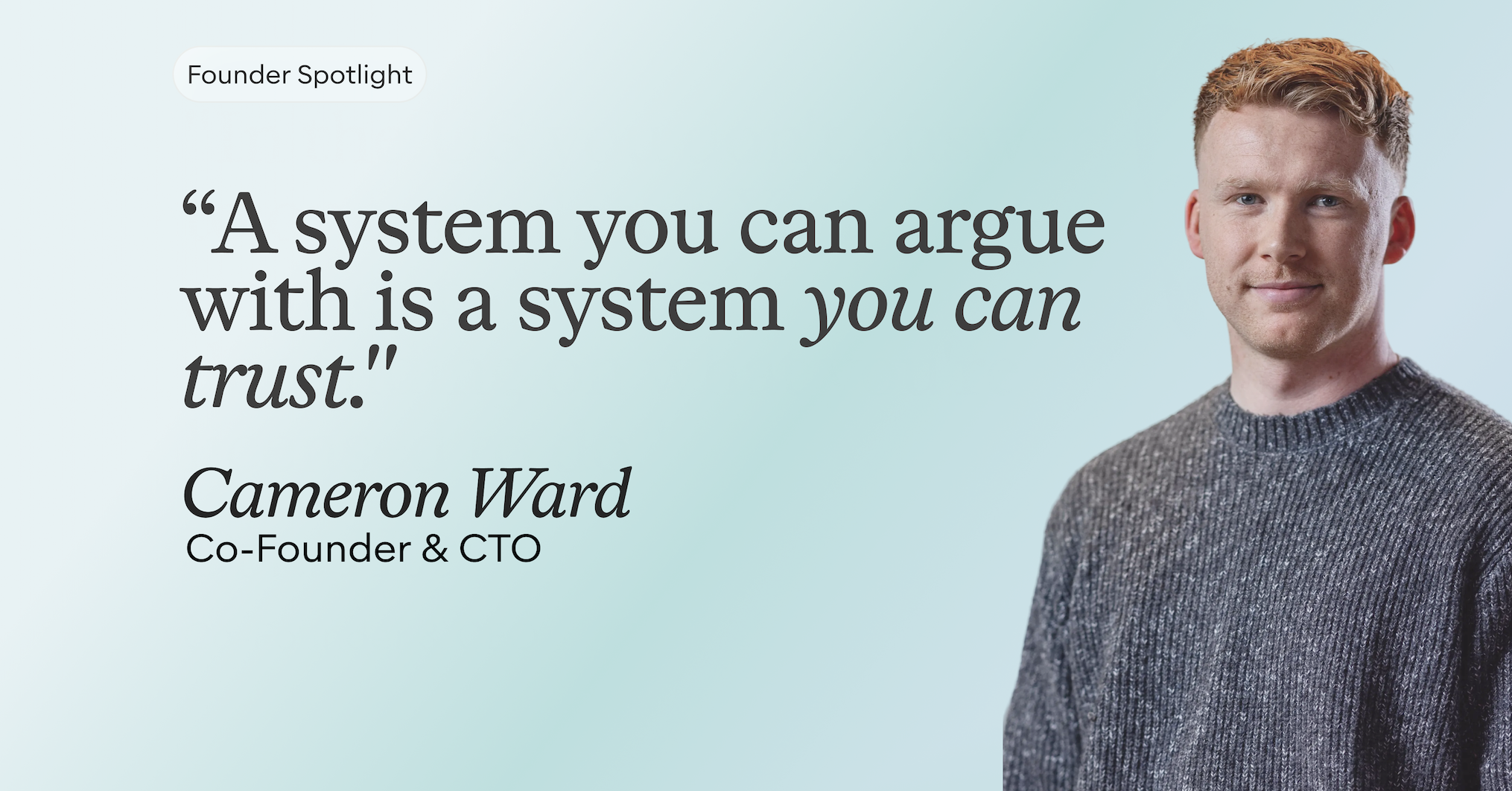
There's a question Cameron Ward says he gets on almost every demo, and it's always some version of the same thing. If the AI approves a promotion and a year later the regulator asks why, what does the firm actually show them. Adclear's CTO thinks it's the right question, and he's blunt that in a lot of AI products it has no good answer. A model returns a result, the result looks reasonable, and nobody can reconstruct how it got there. In most markets you can live with that. In financial services you can't, he says, because the firm carries the liability long after the decision, and "the model said so" is not a defence.
So when his engineering team built Adclear’s review system and audit trail capabilities, the ability to explain a decision wasn't a feature bolted on at the end, it informed the entire building process.
Explainable means traceable to a rule, not to a vibe
Cameron is dismissive of the soft version of explainability that a lot of tools offer, where the system produces a sentence or two of reasoning that reads well and proves nothing. That is not what a compliance team needs. When Adclear's system flags something, he says, the firm can see the specific rule behind the flag and trace it back to the exact regulation it came from. A reviewer should be able to follow the line from the decision to the clause that drove it, and inversely, a regulator should be able to follow the same line.
That matters more than it sounds, because compliance teams are right to distrust a black box. Cameron sees the instinct to resist an AI making the call as a healthy one. The way you earn past it, in his view, isn't to ask for trust, it's to make every decision inspectable, so the team can see the reasoning, challenge it, and change the rule if they disagree. " he says. One you can only accept or reject is not.
The hard part is reproducibility, not explanation
Explaining a decision in the moment is the easy half, he argues. The half that makes this genuinely hard is reproducing it later, because by the time anyone asks, the world has moved. The model has been updated. The rules have changed, often because the regulator changed them. A reviewer who corrected the system in March taught it something that affects how it behaves in June.
So a decision can't just be explainable against today's system. It has to be explainable against the system as it was the day the decision was made. That means recording the state, the rule set, and the reasoning at the moment of the call, and being able to stand all of it back up months later. Reproducibility, Cameron says, is a design requirement, not a log file you hope is complete. If you can't reconstruct the exact conditions under which a promotion was approved, you can't defend it, and an approval you can't defend is worse than no approval at all.
The record has to be a by-product, not a project
The last point he makes is about where the evidence comes from. In a lot of organisations, producing the audit trail is its own piece of work. Someone goes back through decisions, assembles the reasoning, and writes it up when an examination looms. That breaks the moment volume goes up, and it breaks completely once the content is machine-generated and there are thousands of decisions a week.
The only version that holds, he says, is one where every decision, whether a person made it or the system did, lands in the trail as it happens. Evidence as a by-product of doing the work, not a separate job you do later. That's the bar his team holds itself to, because "reasonable steps" stops meaning anything if you can't show, on demand, the steps you actually took.
None of this is exotic, in Cameron’s telling. It's just unforgiving. A compliance decision you can't explain, can't reproduce, and can't evidence on demand isn't a decision.
Once you're booked in, we'll send you a free playbook on Financial promotions compliance for FinTechs.