Ask Joe Jordan what a founder does all week and the honest answer is that the question has changed three times since he started. As one of Adclear's cofounders, his week now runs across three things, finding and winning new business, pushing live deals from first conversation to signature, and keeping a close eye on customer health account by account. The fourth, which takes up close to half his time, is people. Coaching the go-to-market team and keeping them pointed in one direction, giving feedback, holding the thing together.
What's striking is how much of that is recent. A year ago Joe and his cofounders spent far more of their time on product, customer service operations, and laying the early foundations. They have since stepped back from that work, deliberately, because expanding into new regions and pushing harder on growth means the founders have to concentrate on the things only they can do.
Product, then business, then organisation
Joe has a simple way of describing how a founder's job changes as the company grows, and it's the through-line of the whole conversation.
At the earliest stage, it's just sales. You get the first customer, you hunt for product-market fit, and you build something that genuinely serves a lot of people well. Nothing else matters yet. In the middle stage, the work multiplies. You raise money, you keep the pipeline growing, and then everything else arrives at once, brand, operations, product, hiring. The company stops being a product and starts being a business.
The stage Adclear is in now, Joe calls the organisation stage. The task is to get the team excellent at specific functions, so the founders can pull back to the few things that genuinely require a founder. Moving deals. Fundraising. Signing accounts. Hiring. "By definition, the only things that we can do," as he puts it. Everything else is something a founder should be working to hand over, not hold onto.
It's a useful frame for anyone earlier on the same path, because it reframes delegation as the job rather than a thing you do once the real work is finished.
A radio advert and a thirty-year reviewer
The idea didn't start in financial services at all. It started with a family member who had spent around thirty years reviewing radio advertising, running her own team of reviewers, checking ads by hand before they aired. She described the manual grind of it to Joe, the repetition, the back-and-forth, the sheer volume passing through human hands.
The timing mattered. This was around 2023, with large language models moving into the mainstream after ChatGPT's launch. Joe was working in venture capital at the time, watching pre-seed startups put the new AI to work, and he made the connection. The same technology pointed at a different problem, the manual review of regulated advertising, looked like it could work.
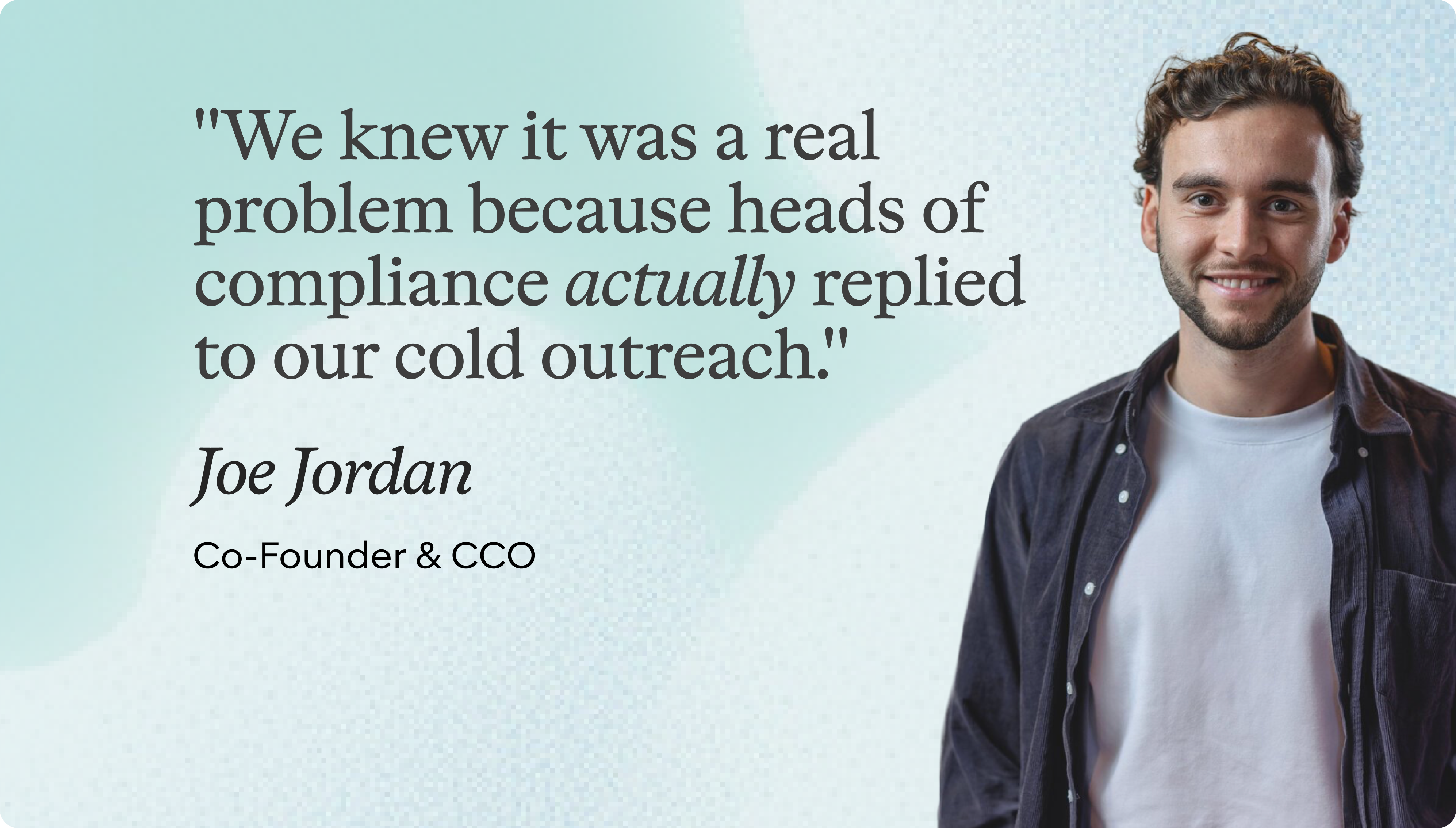
So he built a pilot to prove the technology held up, and brought in his cofounders Doni and Cam to build it properly. Radio turned out to be a tiny market, so the team pivoted to where the same problem was much larger and much more painful, financial services. Doni had connections there from his time at Euronext, which got heads of compliance onto calls early. The clearest signal that the pain was real came from the response itself. "We kind of knew it was a bit of a pain point because they actually responded to our cold outreach," Joe says. Compliance leaders are not famous for replying to strangers. These ones did.
Do only what only you can do
The founder’s story is not all vision and inevitability: it was a family member's unglamorous job, a piece of technology arriving at the right moment, a market that was too small, and a pivot to one that wasn't. The interesting part is the discipline that came after, the deliberate narrowing of what the founders spend their time on as the company grows up around them.
For anyone building in regulated markets, the takeaway is less about the idea and more about the operating model behind it. The founders who scale are the ones who keep asking what only they can do, and give everything else away on purpose.
Once you're booked in, we'll send you a free playbook on Financial promotions compliance for FinTechs.