Cameron Ward has spent the last 18 months building the system that reviews financial promotions. As Adclear's CTO, that vantage shapes how he reads the biggest shift facing his customers, and when marketing teams started generating their campaigns with AI, he says, he saw an engineering problem well before he saw a compliance one.
"The way firms have previously reviewed marketing rests on two assumptions," he explains. "That there's a fixed piece of content to look at, and that a human is the one who's going to read it. Both of those are disappearing at the same time."
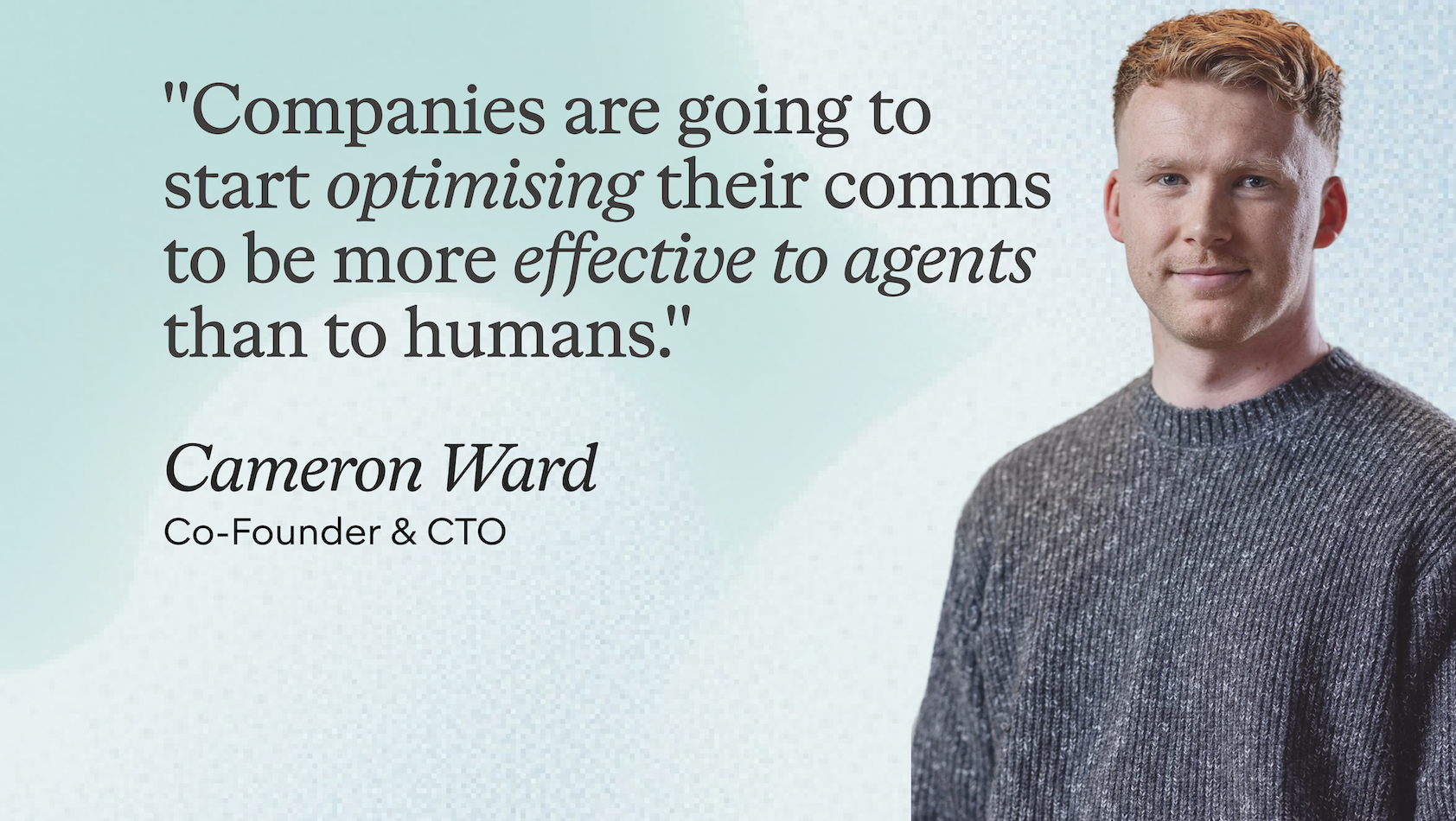
Take the reader first. Around six in ten US adults now say they read the AI summary at the top of a search instead of clicking through to a page, according to Pew Research, and they click the links less often when that summary is present. For a growing share of any brand's audience, its own words are never read by a person at all. "An AI reads them and answers on your behalf," Ward says. People are already asking an assistant which bank to use or which platform to trust, and acting on the reply, which means the next move for marketers is to write for the agent doing the reading, not only for the customer behind it. Ward puts it more bluntly. "Companies are going to start optimising their comms to be more effective to agents than to humans."
The regulator has noticed the same thing. In a horizon scan published this month, the Financial Conduct Authority (FCA) raised the prospect that the audience for a financial promotion may soon not be a person at all. As people hand everyday decisions to AI agents, the agent becomes the thing that reads the ad, ranks it and acts on it, and the human behind it may never look. That unsettles the assumption the whole regime rests on. "Fair, clear and not misleading" was written for a human being informed by what they read. If a machine is doing the reading, it is no longer obvious who you are not allowed to mislead, or what "clear" means to something that parses structure rather than being persuaded by it.
The second shift is the one he finds more interesting, because it lands squarely on the thing he builds. Marketing teams are now generating content at a volume and a level of personalisation that was never possible before, and much of it is generated fresh for each reader rather than fixed in advance. It is assembled at the moment it is served, so often there is no single finished asset to sign off. That, in his telling, is where an engineering problem starts.
You cannot snapshot-review something that changes every time
The traditional model takes a finished asset, puts it in front of a reviewer, and gets a yes or a no. It works because the thing that was reviewed is the thing that ships. Once content is generated per reader, the version a reviewer looked at is one of an effectively infinite set, and the next one out the door is something no human ever saw.
"You can review a fixed screen," Ward says. "You can't review something that comes out different every time in the same way." This is the point where the problem stops being about process and becomes about architecture. The fix is not a stricter rule or another reviewer, it is changing where the check sits in the pipeline. You stop reviewing the document and start reviewing the system that produces documents, at the point it produces them. In his words, that is "a different architecture, not a policy change," with the check running in line, at the moment of generation, fast enough that it never becomes the thing everyone is waiting on.
Why human pre-approval runs out of road
Pressed on whether a human can simply stay in the loop, he is blunt about the arithmetic. "Human review scales with headcount. AI content scales with compute." However, he is quick to add that people still belong in the process for the highest-risk material, and that he would never take them out of it entirely. But a reviewer reading every machine-generated variant by hand will always be slower than the system writing them.
You can hear where that pressure is heading in what customers now ask for. The request landing on his desk is no longer for a nicer review screen. It is for compliance built into the workflow at every step, checking content as it is created rather than waiting at a gate. Often that takes the shape of an API, push content in and get back red, amber or green, with the greens going out and no person watching them. That demand is the clearest sign the old model has run out of road, and it is also the one that keeps him most honest about the engineering. "I refuse to back an automated approval that no human has checked unless we're capable of justifying every detail of the system's reasoning," he says. Before a firm can move a class of content onto that footing, the system has to have proven itself on that exact type of content, the miss rate on it has to sit under a hard line, and every automated pass has to leave the same evidence a human sign-off would have. The greens are the easy part to ship and the hard part to earn.
The only thing that can review machine-made content at the speed it is made, he argues, is another machine. Building that machine well is the real work, and he breaks it into a few things that matter. Increasingly it reviews at the point of generation rather than after the fact, which is the direction the whole thing is heading even if it is not yet a hard rule. It has to learn, so that when a reviewer disagrees with a call the system improves and gets that class of decision right next time, without lurching to overfit the most recent correction. And it has to be tuned for the asymmetry that defines the industry. "A false positive is annoying," he says. "A false negative is the dangerous one. So we hold a hard line on the misses rather than chasing a softer overall accuracy number." He adds that the line is not the same for every firm. "Some customers are risk-averse and want to see everything flagged, even if it adds a bit of noise. Others just want to move fast."
Speed is worth nothing here without the record
The final requirement is the one he says makes financial services harder than anywhere else. In most industries, fast and accurate is the whole goal. Here a third demand sits above both. When the regulator asks why a promotion was approved, the firm has to answer months later, with the reasoning and the specific rule behind the decision.
"A system that runs at machine speed but can't show its working is a liability, not a solution," he says. Every decision the system makes, by a person or automatically, has to land in an audit trail as a by-product rather than as a separate job. Reproducibility, in his view, is a design requirement and not a feature bolted on at the end.
It leaves builders in his position with an uncomfortable but clear brief. The content is exploding, the reader is increasingly a machine, and the review has to be fast, accurate, and fully evidenced at once, with no trading one off against the others. That, Ward says, is exactly why he treats the whole thing as an engineering problem first. "The compliance outcome is what good engineering produces here. Not the other way round."
Once you're booked in, we'll send you a free playbook on Financial promotions compliance for FinTechs.