Anthropic’s launch of Claude for Financial Advisors brings AI further into the everyday work of US wealth management. Alongside connectors to custodians, portfolio platforms, CRMs and planning tools, the product includes skills that can support tasks such as meeting preparation, portfolio analysis and compliance checks.
For financial institutions exploring AI, this creates an obvious question: if Claude can review a communication for compliance, why would a firm need a dedicated marketing compliance platform such as Adclear?
The short answer is that the products operate at different layers. Claude is a general-purpose AI assistant that can help an individual analyse and improve content. Adclear is a purpose-built system through which a regulated firm defines, applies and evidences its marketing compliance process.
Understanding that distinction is increasingly important as regulatory knowledge becomes easier to access through foundation models.
What is Claude for Financial Advisors?
Claude for Financial Advisors is a suite of connectors and workflow skills designed for financial advisory firms. According to Anthropic, it allows advisors to connect Claude to systems including custodians, portfolio reporting platforms, financial-planning software and CRMs. Its skills then use that information to assist with specific workflows, including compliance checks.
Anthropic positions these capabilities as supporting the advisor’s own judgement rather than replacing it. That is an important principle in any regulated workflow: the model can analyse information and generate a recommendation, while the professional remains responsible for reviewing the output and deciding what happens next.
For an advisor drafting an email, social post, newsletter or other client communication, this can provide a useful first pass. Claude may help identify language that deserves closer attention, explain a relevant requirement or suggest a clearer version of the copy.
What Claude’s compliance capability changes
The most significant part of the launch is not any individual compliance feature. It is the demonstration that regulatory knowledge can be packaged as a reusable skill and distributed through a general-purpose AI platform.
Historically, the ability to identify regulatory concerns in content was treated as a major source of differentiation for compliance technology. Foundation models are rapidly making that type of first-pass analysis more accessible. Firms will increasingly be able to ask an AI assistant to assess a communication, identify possible issues and help produce a better draft.
This does not remove the need for specialist compliance technology. It moves the centre of value from knowing the regulation to governing how an individual firm applies it.
Why regulatory knowledge is only one part of the decision
US financial communications are not reviewed against a single universal checklist. The applicable requirements and approval process depend on factors including the type of firm, product, audience, channel and communication.
FINRA Rule 2210, for example, distinguishes between correspondence, retail communications and institutional communications. Those classifications affect the review, approval and recordkeeping requirements that may apply. Registered investment advisers also need to consider the SEC Marketing Rule, while firms may be subject to additional federal, state or internal requirements depending on their activities.
The regulatory text is only the starting point. Each firm must translate those requirements into an operating policy that reflects its products, customers, risk appetite and supervisory structure.
That policy may determine:
- which product claims have been substantiated and approved;
- which disclosures must accompany a claim in a particular context;
- which words, comparisons or performance statements require escalation;
- which communications qualify for a lower-risk review route;
- which reviewers or principals must approve different types of content; and
- what evidence must be retained to reconstruct the decision later.
Two firms can therefore review similar language and reach different, defensible conclusions. The important question is not simply whether an AI model knows the relevant rule. It is whether the system applies the firm’s chosen interpretation consistently and records how the resulting decision was made.
Claude vs Adclear: what is the difference?
Claude and Adclear should not be understood as equivalent products with different interfaces. Claude provides broad intelligence that can assist with many advisory workflows. Adclear provides the specialist control layer for financial marketing and communications.
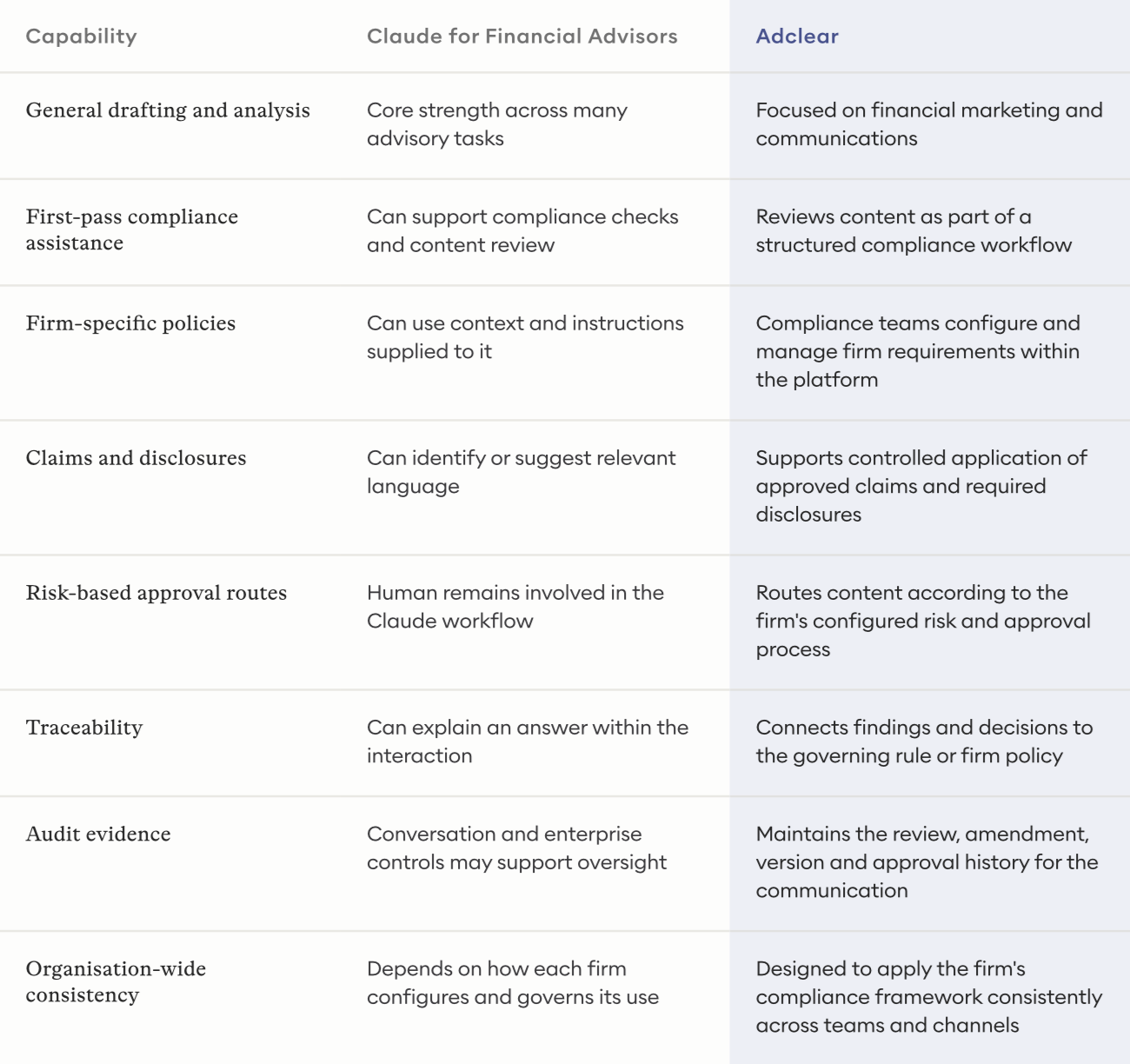
The distinction is between assistance and infrastructure. Claude can help a person assess a communication. Adclear helps the firm operate the system through which communications are reviewed, approved and evidenced.
Can financial firms use Claude for compliance review?
Claude can be a valuable tool within a compliance workflow, particularly for research, drafting, summarisation and preliminary analysis. Firms should still decide how its output will be validated, which data and policies it can access, when human review is required and how decisions will be recorded.
A useful evaluation should go beyond asking whether the model produces a convincing answer. Firms should consider whether they can demonstrate:
- which regulatory and internal requirements were applied;
- why those requirements were relevant to the communication;
- whether the answer reflected the latest approved firm policy;
- how uncertain or conflicting requirements were escalated;
- who reviewed and approved the final content; and
- which version was ultimately published.
These controls are what allow an isolated AI interaction to become part of a repeatable and defensible business process.
Could Claude replace marketing compliance software?
Claude may replace some manual research and first-pass checking. It may also improve the quality of content before it reaches compliance. Those are meaningful gains, particularly for advisors and marketing teams that currently begin with little guidance.
Replacing a firm’s marketing compliance system is a different proposition. A dedicated platform coordinates policy ownership, content review, approval routes, evidence, version history and reporting across the organisation. It gives the compliance function control over the process rather than requiring every user to construct the right prompt, provide the right context and interpret the answer independently.
The likely future is therefore not a choice between foundation models and specialist software. Foundation models will provide an increasing share of the underlying reasoning and language capability. Purpose-built platforms will determine how that capability is configured, constrained, evaluated and evidenced for a particular regulated use case.
What this means for the future of compliance technology
Claude for Financial Advisors is an important signal for the market. AI-assisted compliance is moving from experimentation into the everyday technology stack used by financial professionals.
As access to regulatory intelligence broadens, firms will differentiate themselves through the quality of their compliance operating model: how quickly they translate requirements into usable policies, how consistently those policies reach marketing teams and how clearly they can evidence the decisions made along the way.
Adclear is built for that next layer. It enables compliance teams to turn regulation and institutional judgement into firm-specific controls, apply those controls throughout content creation and approval, and retain the complete history behind every decision.
Claude can make compliance intelligence more accessible. Adclear makes that intelligence governable across the firm.
Frequently asked questions
Does Claude for Financial Advisors include compliance checks?
Yes. Anthropic describes compliance checks as one of the tasks supported by the skills included with Claude for Financial Advisors. The product is designed to support the advisor’s judgement, with the professional remaining involved in decisions and actions.
Is Claude a financial communications compliance platform?
Claude is a general-purpose AI system with workflows tailored to financial advisors. It can assist with compliance-related analysis, but it is not positioned as a complete system for managing a firm’s marketing rules, risk-based approvals and communication-level audit trail.
What is Adclear?
Adclear is an AI-powered compliance platform for financial marketing and communications. It enables firms to configure their own regulatory and internal requirements, review content, manage approvals and preserve evidence of the complete decision-making process.
Can Claude and Adclear be used together?
Yes. General AI tools can support research, drafting and content creation, while Adclear governs the specialist review and approval process before a financial communication is published.
See how Adclear helps US financial institutions review and approve marketing communications with firm-specific controls and a complete audit trail. Book a demo
Once you're booked in, we'll send you a free playbook on Financial promotions compliance for FinTechs.