
Crypto firms and investing platforms can speed up marketing approvals by agreeing review routes in advance, giving reviewers complete evidence and checking time-sensitive claims again before publication. Each campaign also needs an owner who can update or pause it when the facts behind it change.
A sharp market move can give your marketing team a useful reason to communicate with customers. An investing platform might explain an earnings announcement. A crypto firm might publish commentary on a change in trading activity. The content needs to reach people while it is relevant, with enough context to help them understand what has happened.
That becomes difficult when the reviewer receives a screenshot without its source data, the designer is working from an older draft, or nobody knows who can approve the final version. By the time those questions are resolved, the campaign may need another update.
An effective marketing approval process prepares for those situations. This guide sets out a practical workflow for crypto and investing teams, covering UK financial promotions and US investment advertising and communications. The operational steps are shared; the review requirements depend on the entity, product and audience.
What is a marketing approval process for financial services?
A marketing approval process is the workflow a firm uses to check content, document decisions and authorise publication. For financial promotions and investment advertising, it should connect the exact asset to its supporting evidence, intended audience, distribution channels and applicable requirements.
The legal route for communicating a promotion comes first. An internal sign-off workflow does not itself give a firm permission to communicate or approve financial promotions. Crypto firms targeting UK consumers must use an applicable lawful communication route, as explained in the FCA’s guidance for cryptoasset firms.
For US campaigns, identify the legal entity issuing the communication and the service being marketed before choosing the review route. A brokerage app, an investment adviser and a crypto trading business may operate under different requirements, even when customers encounter them under the same brand.
How do UK and US marketing approval requirements differ?
The UK financial promotions framework and US advertising rules use different categories and approval requirements. Build those differences into campaign intake so the right reviewer receives the content from the outset.
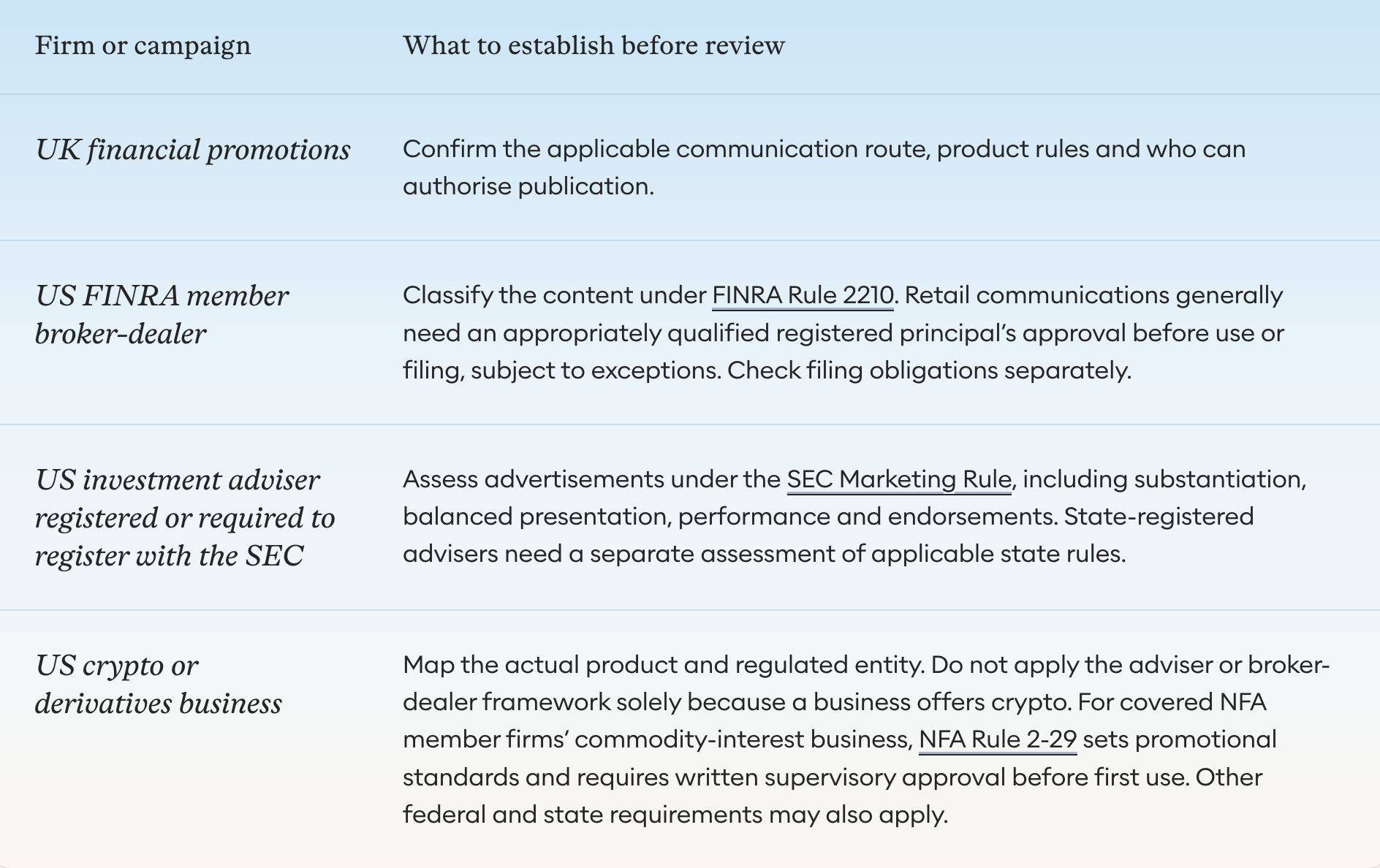
A platform operating across both countries should record the relevant entity and market against each campaign version. This also helps prevent a claim about one entity’s registration or customer protections being carried over to another product without review.
Once that is established, the operational task is to make each review complete and repeatable. A reviewer should be able to see what customers will encounter, why the claims are supportable and who is responsible for the decision.
How can teams approve time-sensitive marketing faster?
Teams can reduce avoidable delays by preparing reusable materials, routing submissions according to risk and resolving basic issues before formal review. Here is how to put that into practice.
1. Agree review routes before a market event
Define which content types your team produces and what review each requires. A routine update using an established format may need a different route from a new product campaign or a promotion containing performance claims.
Consider the product, audience, jurisdiction, channel and claims together. A familiar template can still contain a new claim that needs scrutiny. A short push notification can also require careful review if it encourages a financial decision.
Set a named reviewer, a backup and an escalation route for each category. Agree what happens when the intended publication window closes. Marketing should know whether to refresh the submission, move it to another slot or cancel it.
Where permitted by the firm’s legal obligations and governance, self-approvals can support defined categories of lower-risk content. Eligibility should be explicit, with clear boundaries on what can change. A clean automated check alone does not establish that a promotion can legally be published. For a FINRA member, an internal “low-risk” label cannot override required principal approval. Encode applicable exceptions and supervisory procedures in the workflow before enabling self-approvals.
2. Prepare reusable claims and evidence
A claims library can give marketers a reliable starting point for recurring statements about products, pricing and services. Each entry should explain where the claim can be used and link to its evidence.
Record the approved wording, relevant product and audience, supporting source, required qualifications and review owner. Include an expiry date or a condition that triggers reassessment where appropriate.
Treat changing figures separately from stable product descriptions. A price movement needs a source and timestamp. A performance figure needs its calculation basis and period. A fee claim needs to reflect the charges relevant to the offer. Reusing approved wording is helpful only while the evidence and context still support it. For an SEC-regulated adviser’s performance advertisement, identify whether results are actual, extracted or hypothetical. Gross performance generally needs corresponding net performance, subject to the rule’s conditions. Hypothetical results require specific policies and audience-related safeguards. Store the methodology and assumptions with the claim so the reviewer can assess the relevant requirements.
3. Submit the campaign with its context
Give the reviewer a complete submission containing:
- The copy, artwork and relevant landing page or destination.
- The issuing legal entity, product, target audience, jurisdiction and distribution channels.
- For US content, the applicable communication category and any required filing or supervisory review.
- Sources and calculations supporting numerical or comparative claims.
- The intended publication time and campaign duration.
- The required decision-maker and an owner for later updates.
For example, a crypto market update should identify the asset, price source, comparison period and time of measurement. A statement that an asset is “up today” is difficult to assess without knowing what “today” means and when the number was captured. For a campaign spanning the UK and US, specify the timezone and publication window for each version. A number captured during the London morning may need fresh context by the time a US campaign is scheduled.
The same principle applies to an investing platform’s chart. Reviewers need the underlying data and methodology alongside the graphic, including whether charges affect the result shown.
4. Resolve issues while the content is still being drafted
Early checks help marketers identify missing support, inconsistent figures or wording that needs closer attention before a submission reaches its approver. AI can assist with those checks against the firm’s configured rules and policies.
Keep substantive feedback attached to the asset. If a reviewer questions a return claim, the marketer should be able to see the specific wording, the concern and the evidence needed to resolve it.
Reviewing copy before artwork can also reduce rework. The final designed asset still needs the relevant checks: layout, prominence and surrounding imagery can affect what the customer takes away. The FCA’s social media guidance is a useful reference when adapting promotions to different formats. US broker-dealers should also check the final presentation against FINRA’s fair-and-balanced content standards. A disclosure in a separate destination should not be treated as an automatic fix for a misleading headline.
5. Check the publication version against the decision
Approval should identify the exact version and any conditions on its use. Before publication, confirm that the asset being scheduled matches that version and that time-sensitive claims remain accurate.
A historical statement tied to a specific date does not become false simply because the market moves. Wording that implies a current price, rate or return may need updating. The distinction matters when deciding whether a campaign can still run as planned.
If a material figure changes, return the revised asset through the appropriate review route. Updating a number can also affect a chart, headline or conclusion, so the review should consider the resulting message as a whole.
When should approved marketing content be reviewed again?
Reassess a promotion when changes to its content, evidence, audience or distribution could affect its accuracy or compliance. Build those triggers into the campaign plan so the team knows when to act.
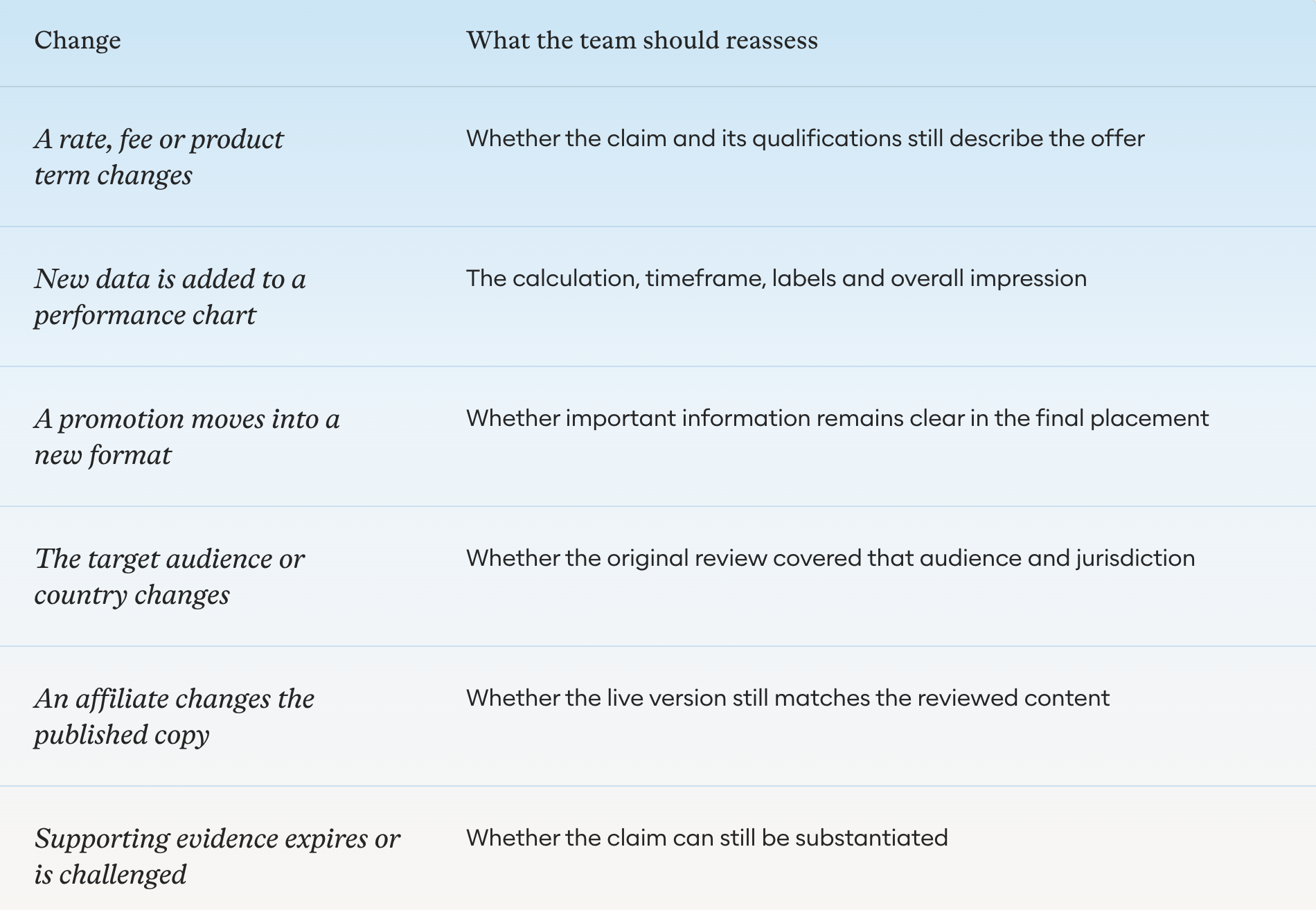
These are practical review triggers, rather than a universal legal timetable. The appropriate response depends on the promotion and the applicable rules. Where a firm approves promotions for an unauthorised person, COBS 4.10 includes specific ongoing obligations and provisions for withdrawing approval when a promotion no longer complies.
For US campaigns, connect the correction process to the firm’s supervision and recordkeeping procedures. Preserve the original communication and its review history alongside the corrected version, with dates of use where required.
Assign someone who can coordinate changes across paid ads, landing pages, email and partner content. Finding an outdated claim is useful only if the team can locate the affected versions and correct or pause them.
What does the workflow look like in practice?
Consider a fictional investing platform preparing a social post about a market index’s recent performance. The marketer uses an established format and includes the data source, measurement period and explanation of the calculation. An early check highlights an unsupported comparison, which the marketer removes before submitting the campaign.
The reviewer assesses the revised copy and final artwork, then records the decision against that version. Before publication, the campaign owner checks that the post still accurately describes the period shown and that the scheduled asset is the approved file.
If the team later extends the chart to include another month, it submits the revised chart for the appropriate review. The original evidence and decision remain available alongside the new version.
For a US broker-dealer version, the team first establishes the communication category and whether principal approval or filing is required. An SEC-regulated adviser using its own strategy results would need a different evidence pack, including the applicable performance presentation checks. That distinction should be made during preparation, before either version reaches its reviewer.
For a crypto campaign, the same operational structure can help organise review, but the applicable requirements must be assessed separately. The FCA’s cryptoasset promotions guidance explains expectations for fair, clear and not misleading promotions of qualifying cryptoassets. In the US, map the crypto product and entity to the relevant requirements before adapting the workflow. A process used for an investment product should not be assumed to cover crypto unchanged in either market.
How should you measure approval performance?
Measure elapsed time from a complete submission to a decision, then separate time spent waiting from time spent actively reviewing. That helps reveal whether delays come from missing evidence, reviewer availability or repeated revisions.
Track the proportion of submissions approved first time, the number of revision rounds and campaigns that miss their intended publication window. For live content, measure how long it takes to correct an issue after discovery.
Use the findings to improve the process. Repeated questions about pricing may indicate that the claims library needs updating. Frequent artwork changes may show that the design team needs clearer guidance on presenting qualifications. More complex campaigns may need earlier involvement from the relevant specialist.
How Adclear supports marketing approvals
Adclear’s pre-publication approvals bring AI checks, configurable approval workflows, version tracking and decision records into one process. Marketing teams can address feedback during preparation, while reviewers work from the relevant content and supporting context.
Post-publication monitoring helps teams review live content and identify changes across supported channels. Firms still need to assign owners and define what happens when an issue is found.
For crypto firms and investing platforms, the goal is a process that is ready when a campaign opportunity arrives, with a clear record of what was reviewed and a practical way to maintain accuracy afterwards.
Explore Adclear’s marketing approval workflows and book a product tour to see how they could support your team.
Frequently asked questions
Can a template be reused without another review?
A template can reduce preparation time, but reuse depends on its approved scope and the firm’s governance. Changes to claims, figures, products, audiences or channels may require another review. Check the completed asset against the conditions for reuse.
Can AI approve financial promotions or US investment advertising?
AI can support checks and routing, but an AI result is not legal approval. The firm must establish the applicable regulatory requirements and who can authorise publication in each market. Any self-approval process must operate within those obligations and the firm’s documented controls.
Do all market movements require an ad to be reviewed again?
No. The relevant issue is whether the movement affects the ad’s claims or overall impression. A clearly dated historical figure may remain accurate, while a claim presented as current may need updating. Define the trigger for each time-sensitive claim.
Can the same campaign run in the UK and US?
The creative concept can be shared, but each version should be assessed for its entity, product, audience and destination market. Check claims, disclosures, performance presentation and approval requirements separately, and keep the decision for each version traceable.
What should an approval record contain?
A useful record connects the final asset, supporting evidence, intended audience and channels, reviewer, decision date and any conditions on use. Keep revisions and reasons for decisions accessible so the team can explain how the published version was reached. For US advisers, preserve advertisements and the records required to support performance information under the applicable books-and-records rules. Configure retention and storage to the relevant regime; a workflow log alone does not establish recordkeeping compliance.
Once you're booked in, we'll send you a free playbook on Financial promotions compliance for FinTechs.