The short version
The best marketing compliance software for UK financial services does three things a generic project management or proofing tool can't. It enforces FCA-specific rules at submission (prescribed risk warnings, crypto cooling-off, Consumer Duty readability, FG24/1 social media logic). It produces an immutable evidence-backed audit trail that survives an FCA skilled-person review under SYSC 9.1R. And it monitors live creative against its approved version after publication. Everything else (workflow, routing, comments, sign-off) is table stakes. Get those three right and the category collapses from a shortlist of 15 vendors to a handful of purpose-built contenders.
The shortest diagnostic: if you can't produce a complete approval chain for a random promotion from six months ago in under 15 minutes, your current stack isn't marketing compliance software. It's project management with a compliance label.
Why this category exists now
Three forces have converged.
Volume. A mid-sized FCA-regulated firm now produces between 100 and 1,000 promotional assets a month across paid, social, affiliate, in-app, and email. Manual review scales linearly. Volume scales exponentially.
Enforcement. In 2024 the FCA intervened in 19,766 financial promotions, up from around 10,000 the year before. The 2024 consultation on the approver permission regime for s21 approvals (CP24/26) and the 2025 rules have raised the evidentiary bar for every promotion an authorised firm signs off, including affiliate and principal-representative arrangements. The FCA is scraping social in real time, not waiting for complaints.
Consumer Duty. Since PRIN 2A came into force, "compliant wording" isn't the only test anymore. Consumer understanding (reading age 11-13, no cross-sell by stealth, balanced prominence of risks) is tested at the outcome level. A promotion that would have passed in 2022 fails under Consumer Duty without ever changing a word.
The result: review volume is up, the test is harder, and the audit standard is higher. Spreadsheet-plus-email does not get you there.
"We hired three compliance reviewers in 18 months and still missed the FCA's clock on a social repost. Headcount was not the answer. A rule library and a clock was."
Signs you need dedicated software, not a better spreadsheet
A handful of buying triggers reliably signal the inflection point:
- First-time approval rate sits below 70%. (Benchmark: mature operating models run 80-90%.)
- Median approval cycle is longer than five business days (the cycle is the bottleneck, not the reviewer).
- You hired a compliance reviewer in the past 12 months primarily to absorb volume (roughly £80-120k loaded).
- A marketing channel (paid social, affiliate, a new crypto product) is on hold because compliance has no capacity.
- You can't reconstruct the approval evidence for a specific live ad without messaging three people and searching two inboxes.
- The FCA asks for a thematic sample and the audit-pack assembly takes a week.
- You are about to become an s21 approver for unauthorised persons and your current sign-off evidence is a PDF and a Slack thread.
If three of those are true, the payback window is short. A single avoided compliance hire typically covers the software inside 9 months.
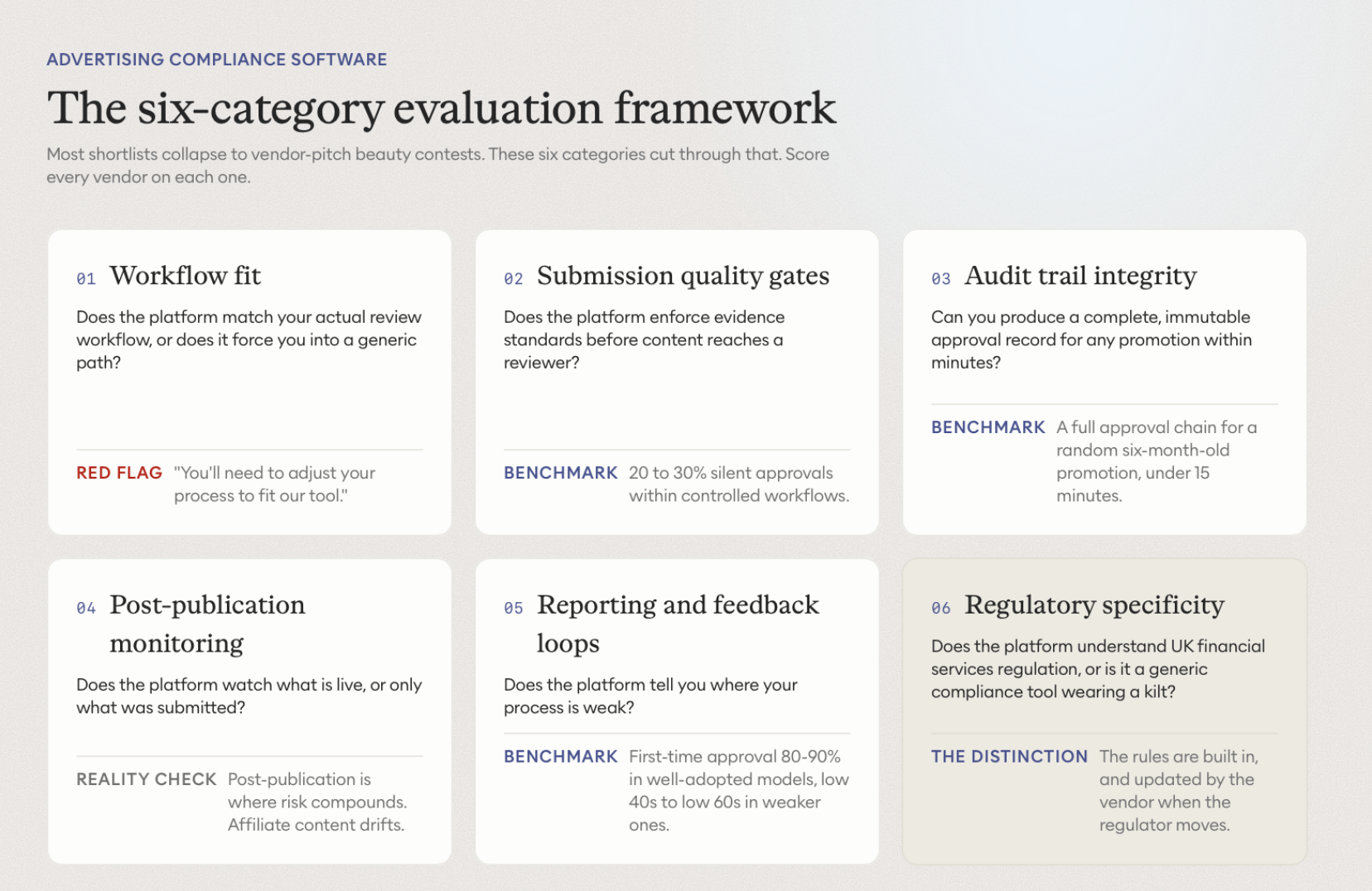
The six-category evaluation framework
Most shortlists collapse to vendor-pitch beauty contests. These six categories cut through that. Score every vendor on each one.
1. Workflow fit
Does the platform match your actual review workflow, or does it force you into a generic path?
Ask: can it support multi-stage review (marketing QA → compliance → senior sign-off)? Does it handle multiple product types with different rules? Can it route by risk level, product type, jurisdiction, or channel? Does it integrate with the tools the team already uses (Jira, Workfront, Figma, Slack, Gmail)?
Red flag: the vendor says "you'll need to adjust your process to fit our tool." The tool should configure to the process, not the other way round.
Scenario. One mid-market wealth platform ran a four-stage workflow across eight jurisdictions with repeated amendment cycles driven by regional and regulatory feedback. Generic PM tools broke at that complexity. The workflow engine could hold the states, but not the policy logic beneath them. A purpose-built platform held it structurally: the same asset carried different risk-warning requirements per jurisdiction, routed to different reviewers, under different deadlines, without forking the record.
2. Submission quality gates
Does the platform enforce evidence standards before content reaches a reviewer?
Ask: can you make fields mandatory (evidence links, substantiation, risk-warning markers, audience targeting)? Does it validate completeness at submission? Can you build product-specific checklists (crypto requires cooling-off flag + prescribed warning + appropriateness assessment; CFD requires loss percentage; pensions require scam disclaimer)? Does it check readability and formatting automatically?
Why it matters. A more credible early automation benchmark in regulated marketing isn't full autonomy from day one. It's 20 to 30% silent approvals within controlled workflows. That only works if submissions are structured enough for rules to evaluate them. Garbage in, queue bloat out.
3. Audit trail integrity
Can you produce a complete, immutable approval record for any promotion within minutes?
Ask: does every action get a timestamped log? Are user IDs recorded, not just display names? Is the trail tamper-proof, so a reviewer can't edit their approval reason after the fact? Can you export the full approval file per promotion for FCA review? Does it track which version each reviewer signed off on, pixel-accurate?
Benchmark. If you can't produce a full approval chain for a random six-month-old promotion in under 15 minutes, your audit trail has gaps. The FCA will find them before you do.
4. Post-publication monitoring
Does the platform watch what is live, or only what was submitted?
Ask: does it monitor live URLs, social posts, and affiliate pages? Does it flag changes to approved content (the silent live edit is a common failure mode)? Does it detect broken evidence links or stale comparative claims? Can it scan across multiple sites and channels automatically?
Reality check. Most platforms focus on pre-publication approval. Post-publication is where risk compounds, because changes happen after sign-off and nobody is watching. Affiliate content, in particular, drifts; the approved page six months later is often not the page under review.
5. Reporting and feedback loops
Does the platform tell you where your process is weak?
Ask: can you see first-time approval rates by product, channel, or team? Rejection reasons grouped by category? Time-to-approval trends? Can you use rejection data to retrain submitters systematically, or is the feedback trapped in comment threads?
Why it matters. Across operating models we've seen, first-time approval ranges from the low 40s to low 60s in weaker environments, versus 80-90% in well-adopted ones. The delta is almost always feedback loops: knowing what's failing and why, then turning that into submitter training rather than another reviewer hour.
6. Regulatory specificity
Does the platform understand UK financial services regulation, or is it a generic compliance tool wearing a kilt?
Ask: does it know FCA prescribed risk warnings verbatim? Does it handle crypto-specific rules (8 October 2023 regime, cooling-off, refer-a-friend ban, high-risk audience restrictions, four lawful promotion routes)? Consumer Duty readability gates (PRIN 2A)? FG24/1 for social? COBS 4.2 fair-clear-not-misleading enforced natively? Section 21 FSMA approver permission logic?
The distinction. A generic compliance tool asks you to upload your rules and reason about them. A financial-services-specific tool has those rules built in and updated by the vendor when the regulator moves. The gap is implementation speed and accuracy.
When manual is enough (and when it is not)
Manual still works if: you produce fewer than 50 promotional assets per quarter, your team is small and co-located, you operate in a single channel, your compliance team is stable with consistent standards, and you are not under active regulatory scrutiny.
You need dedicated software when: you are processing 100+ promotions a month; the team is distributed across marketing, compliance, legal, and agencies; you operate across multiple channels; you need audit trails that survive FCA inspection; first-time approval is below 70%; campaigns regularly take more than five business days; or you are about to take on s21 approver responsibility for unauthorised persons.
The inflection point is usually where one compliance hire costs £80-120k loaded and the platform costs £20-40k in tooling. Break-even sits at 6-9 months.
What "good" looks like in operating benchmarks
A well-implemented marketing compliance platform inside an FCA-regulated firm typically hits this steady state:
MetricEntry-stage (manual / PM tool)Mature (dedicated platform)Volume50-150 per month1,000+ per month across 18+ sitesMedian first-approval time3-5 business daysUnder 4 hoursFirst-time approval rate40-60%80%+Post-publication monitoring effort30-40 hours per month5-10 hours per monthInternal NPS (marketing submitters)Negative80Audit-pack assembly for one promotionDaysMinutesFCA intervention rateRising with volumeFlat or falling
That isn't "no compliance." It's compliance at a speed that doesn't bottleneck growth. Early-stage workflows sit at 40-60% first-time approval with 10-20 business-day cycles. Mature platforms hit 80-90% with the majority of submissions resolved within four business days.
"We weren't trying to remove compliance. We were trying to stop it being the reason campaigns missed the launch window. Once the software did the mechanical checks, the compliance team got to spend time on the judgement calls."
Buy vs build vs extend Jira
Three paths show up on every shortlist.
Extend Jira, Workfront, Asana, or Monday. Low upfront cost, fast deploy. The ceiling is low: custom fields are not policy logic, ticket comments are not evidence, and state changes are not sign-off. Works for sub-100-per-month volume with stable rules. Fails at audit.
Build in-house. Tempting when engineering is cheap. In practice, the cost is the regulatory update tax. Every FCA move (FG24/1 updates, CP24/26 approver regime, Consumer Duty calibrations) needs a sprint. Build costs £300k-£800k loaded in year one, plus a permanent 1 FTE to maintain. Maintenance is the hidden bill.
Buy purpose-built. Higher line-item cost, but the regulatory logic updates come in the subscription. The vendor absorbs the FCA's moves. The comparable-time-to-value is 4-12 weeks versus 6-18 months for a build. Defensibility is designed in, not retrofitted.
Objections
"We already use [Jira/Workfront]. Adding a compliance tool is just another system."
It is, and the right answer is that a dedicated review layer doesn't replace your PM tool. It sits inside the stack. Creative still happens in Figma. Briefs still flow through Jira. The regulated decision and its evidence live in one system with audit-grade integrity. The integration mirrors state back. You carry one extra tool, not two extra processes.
"The FCA has not come calling, so why accelerate this now?"
Two reasons. First, the 2024 enforcement figure of 19,766 interventions (H8) shows the FCA is sampling proactively, not waiting for complaints. Second, the cheapest time to build a defensible record is before the skilled-person review. Reconstructing it under pressure is what turns a thematic review into a supervisory outcome.
"Our team will not trust AI-based compliance checks."
Fair. Don't force it. In one regulated operating model, silent-approval mode only unlocked after the system processed 20-30 successful human-reviewed approvals per rule. The fastest path to trust is transparency: show the team the system matches their own decisions. Persuasion comes second. Any platform that can't run in shadow mode first is skipping the hardest part of adoption.
"Consumer Duty is a governance thing, not a software thing."
Partly true. Consumer Duty outcomes sit in governance, but the day-to-day test (did every customer-facing piece meet the reading age, balance-of-prominence, and target-market requirements of PRIN 2A) is a production-line test. Production lines benefit from tools. A governance framework without an enforcement mechanism is a policy PDF.
FAQ
How long does implementation typically take?
For a mid-market fintech with a clear approval workflow, 4-6 weeks from kickoff to live. For enterprise environments with multi-jurisdiction requirements, 8-12 weeks. The variable is internal alignment on review standards (what counts as substantiated, what qualifies as a high-risk product, who is the sign-off of record), not technical setup.
Can we integrate with our existing project management tools?
Most compliance platforms integrate with Slack, Jira, Asana, Workfront, and Gmail. The right question is depth: does the integration just send notifications, or does it pull approval decisions and evidence back into the compliance record? Surface integrations feel good and create audit trail gaps. Insist on state and evidence mirroring, not just notifications.
What is the difference between a compliance platform and a PM tool with custom workflows?
Three things. Regulatory specificity (the tool knows FCA rules, not just your rules, and updates them). Audit trail immutability (records cannot be edited after the fact). Evidence capture (structured metadata per approval, not free-form attachments). You can build approval workflows in Jira. You cannot build FCA-grade audit trails in Jira.
Should we buy a platform covering all regulatory domains or one specific to financial services?
Depends on the compliance portfolio. A diversified financial conglomerate with tax, employment, and environmental exposure may need a broad platform. A fintech where 90% of compliance risk sits in marketing promotions and FCA rules will be faster, more accurate, and cheaper on a purpose-built tool.
How do we measure ROI?
Three metrics: time saved per approval (multiply by volume), compliance hires avoided (£80-120k loaded each), campaigns launched faster (revenue impact of reduced time-to-market). Most teams see break-even in 6-9 months on avoided headcount alone.
What about post-publication? Do we really need it?
Yes. The silent live edit is a common failure mode. A partner changes the page after approval, an affiliate updates copy, a paid team tweaks an ad. Post-publication monitoring catches drift before the FCA does. It also produces the strongest evidence that your approved version was live as approved.
Can the platform handle our crypto compliance requirements?
A purpose-built UK platform handles the 8 October 2023 regime natively: cooling-off enforcement, verbatim prescribed warnings, appropriateness assessment flags, refer-a-friend ban, high-risk audience restrictions, and the four lawful promotion routes (FCA-authorised, s21 approver, MLR-registered with exemption, exempt category). Generic tools do not.
Adclear's point of view
Marketing compliance software is only as good as the operating model it supports. A tool that enforces bad standards faster is just bad standards at scale. Get the governance right first: define your evidence requirements, tier your review levels, and write down what "compliant" means for each product type. Then tool it.
Adclear is automated pre-submission marketing-compliance software built specifically for UK financial services. It enforces FCA-specific rules at submission (prescribed risk warnings, crypto cooling-off flags, Consumer Duty readability gates, FG24/1 social guidance), routes work by risk tier, captures structured evidence for every approval, and creates audit trails that survive regulatory scrutiny. One workflow moved from sub-50% first-time approval to 80%+ within 8-12 weeks, largely by tightening the entry standard and automating the mechanical checks that had been eating reviewer time.
We're honest about what a tool can and can't do. It can't fix a broken governance model. It can make a good one faster, more consistent, and more defensible.
Next step
Two diagnostics will tell you more than a 30-page RFP.
First: what is your current first-time approval rate, by product and by channel?
Second: how long would it take you to produce a complete audit trail for a random promotion from last quarter?
Book a 30-minute product tour with Adclear. We walk through the six-category framework against your current workflow, show where automation is safest to start, and where headcount is the wrong lever. The firms that win at compliance aren't the ones with the biggest teams. They're the ones with the best systems.
Once you're booked in, we'll send you a free playbook on Financial promotions compliance for FinTechs.