Summary - This guide compares the marketing and financial promotion compliance software platforms that regulated financial services firms are actually evaluating in 2026, including Adclear, Haast, Norm AI, Sedric, Warrant, Red Marker, and Blee. It's written for compliance and legal leaders (CCOs, Heads of Compliance) and marketing leaders (CMOs, Heads of Marketing) at banks, fintechs, crypto and trading platforms, asset managers, and insurers who need to move promotional content through review faster without losing regulatory control. Every claim below is sourced to a vendor's own published materials, a named case study, or independent reporting, and anything that couldn't be independently confirmed is flagged as such rather than stated as fact.
What is marketing compliance software?
Marketing compliance software (sometimes called financial promotion compliance software or ad compliance software for regulated industries) is a category of tools that review marketing content, financial promotions, and customer communications against regulatory rules and internal policy before publication, after publication, or both. For financial services specifically, that means checking ads, social posts, disclosures, landing pages, and sales collateral against frameworks like the FCA's financial promotion rules, SEC and FINRA marketing rules, MiFID II, and consumer protection statutes such as UDAAP, before a marketer's finger ever hits "publish," and then watching what actually goes live to catch drift, unauthorized reposts, or content a partner or affiliate pushed out without approval.
The category sits between two older approaches that firms have relied on for years: manual sign-off by a compliance team member reading each asset by hand, and generic brand or DAM (digital asset management) tooling that checks formatting and brand guidelines but has no regulatory logic built in. AI marketing compliance software for financial services is meant to replace the slow, inconsistent parts of manual review while keeping a human compliance officer as the final decision-maker, which is the model most FCA and SEC-regulated firms need to satisfy their own governance obligations.
How we evaluated these platforms
Every vendor in this comparison was assessed against the same seven criteria, chosen because they map directly to what compliance and marketing leaders at regulated financial firms actually ask about during procurement:
- Pre-publish review coverage. Does the platform check content before it goes live, and across which formats (text, image, video, audio, design files, presentations)?
- Post-publish live monitoring. Does it continue watching content after publication, across owned channels, social, and partner or affiliate sites, to catch drift from the approved version?
- Customization and risk-tolerance tuning versus generic rule libraries. Can compliance teams tune the platform to their firm's specific risk appetite and internal policy, or does it apply the same rules to every customer?
- Financial-services regulatory depth. Does the platform understand FS-specific nuances, such as past-performance disclaimers and jurisdiction-specific disclosure requirements, or is that logic bolted on top of a generic content-review engine?
- Implementation team expertise. Who actually configures and supports the platform: compliance professionals and lawyers, or generalist customer success staff?
- Content formats supported. Native creative files (Figma, video, audio) versus text and static image only.
- Jurisdictional coverage. How many regulatory frameworks and jurisdictions the platform's knowledge base actually covers, and how that's kept current.
Where a vendor's own marketing makes a claim we couldn't independently verify (a review count, an implementation team's legal credentials, a funding total), we've labeled it as a vendor claim rather than presenting it as fact.
How to choose: a 2026 checklist
Compliance review turnaround is the most consistently cited pain point in this category. One widely shared example: an RIA marketing team once waited 11 days for a single LinkedIn post to clear compliance, against an industry benchmark of 24 to 48 hours that firms like Commonwealth Financial Network treat as good practice. Slow review pushes teams toward shortcuts, and it comes as content volume keeps growing across more social and affiliate channels faster than review capacity can keep up.
Beyond speed, two other problems recur across firms evaluating this category. Different human reviewers apply different standards on different days, so what clears on Monday can get flagged on Friday. And manual approval processes built on email chains don't produce the systematic, timestamped documentation that regulators expect to see during an examination. Rising regulatory exposure is also pushing more firms to evaluate software proactively rather than reactively, since a single enforcement action or fine is often the trigger that finally gets budget approved.
With that in mind, here's a working checklist for evaluating platforms in 2026:
- Does it review content before publication across every format your team actually produces, not just text and static images?
- Does it keep monitoring content after it goes live, including on social platforms and any affiliate or partner channels you don't directly control?
- Can it be trained on your firm's specific policies and risk tolerance, rather than applying one generic rule set to every customer?
- Does it have real depth on financial services regulation specifically (FCA, SEC, FINRA, MiFID II, and the jurisdictions you operate in), rather than treating finance as one vertical among many?
- Is the team implementing and supporting it made up of people who understand compliance and regulatory work, not just software onboarding?
- Does it produce an audit trail that would hold up during a regulatory examination?
- Does it integrate into the tools your creative and marketing teams already use, so compliance isn't a separate step bolted onto the end of the workflow?
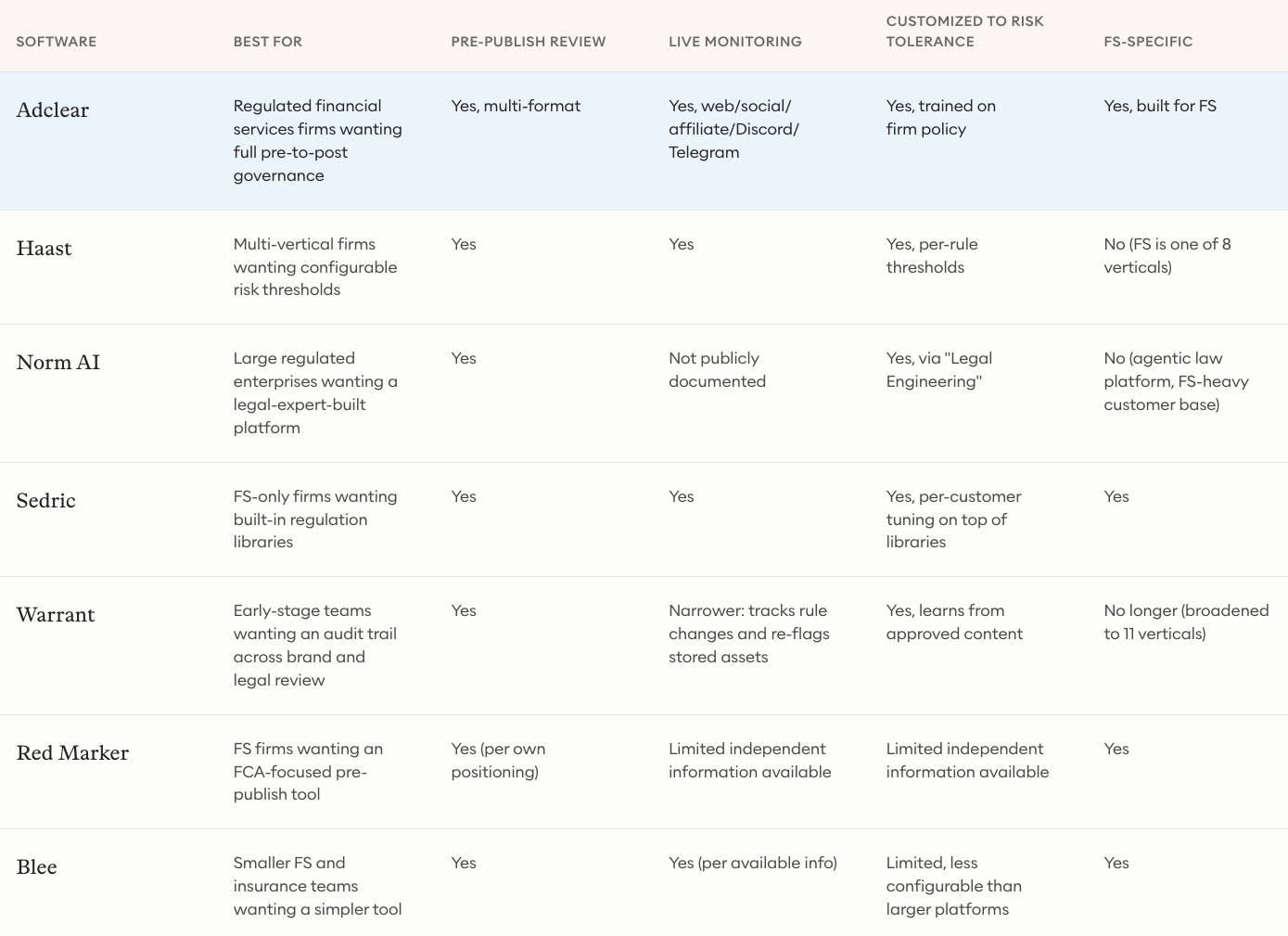
At-a-glance comparison
Provider-by-provider breakdown
Adclear
Overview. Adclear is a compliance-in-the-loop AI platform built specifically for regulated financial services marketing compliance. It covers the full lifecycle of a financial promotion, from a first draft inside a creative tool through continuous monitoring of the live asset. The pre-publication workflow accepts multi-format content, including images, video, text, audio, Figma files, PDFs, and presentations, and returns AI-powered compliance review with citations and explanations rather than a bare pass or fail. Approval chains are configurable, low-risk content can be routed for self-approval, and native-preview rendering shows exactly how an asset will look on the social platform it's headed to. Post-publication, Adclear runs automated scans across websites, social media, affiliate sites, Discord, and Telegram, comparing live assets against the approved version to catch drift and routing any deviation into a remediation workflow with pre-filled takedown letters. Partners and affiliates get their own dedicated workspaces, which matters for firms whose promotional exposure extends well past their own marketing team.
The regulatory foundation underneath all of this is a centralized, versioned Regulatory Governance and Knowledge Hub covering frameworks including the FCA, ASA, SEC, FINRA, and MiFID II across more than 40 jurisdictions, with automated updates, policy-to-rule traceability, and exportable, regulator-ready audit trails. Adclear's architecture keeps a human compliance expert in the final decision-making seat: the AI handles the repetitive audit work, but sign-off authority stays with the firm's own team, and the platform is trained on that firm's specific policies rather than a generic rule set. It integrates natively into Figma, Slack, Google Workspace, Monday.com, Braze, Contentful, Jira, and Workfront, with a REST API and webhooks for anything custom. Each customer runs in an isolated data environment, under a formal model risk management framework aligned with SR 11-7 and PRA SS1/23, with customer data excluded from foundation-model training. Across its client base, Adclear's average first-time approval rate is 88 percent, against an industry benchmark of roughly 30 percent for firms not using marketing compliance software, a difference that translates directly into fewer review cycles and faster time to publish.
Strengths. Full pre-to-post coverage built specifically for financial services, not adapted from a generic platform. An 88 percent average first-time approval rate across Adclear's client base, compared with an industry benchmark of roughly 30 percent for firms reviewing content without dedicated compliance software. Deep regulatory knowledge base spanning FCA, SEC, FINRA, ASA, and MiFID II across 40+ jurisdictions with automated updates. Native support for creative file formats (Figma, video, audio, presentations) that many competitors don't handle. A human-in-the-loop model that keeps final sign-off with the firm's own compliance team rather than automating the decision away. Formal model risk governance (SR 11-7, PRA SS1/23) and per-customer data isolation, which matters to enterprise procurement and security review.
Weaknesses. As a platform built specifically for financial services, Adclear is a narrower fit for firms outside regulated finance looking for one tool across multiple industries.
Haast
Overview. Haast is an industry-agnostic compliance platform serving eight verticals, including a dedicated financial services offering built around FCA, FINRA, UDAAP, ASIC, APRA, and SEC frameworks. It reviews content pre-publish inside Figma, Microsoft Office 365, Workfront, Google Docs, and Monday.com, and monitors live assets and channels post-publish, including partner and affiliate content. Its central differentiator is configurable per-rule risk thresholds, letting compliance teams tune the platform to their own risk appetite. Zurich Insurance is a named case study customer, with Haast's own materials claiming the platform cut TMD/PDS drafting time in half.
Strengths. Genuinely broad pre-to-post coverage with a strong Figma and Office integration story. A named enterprise financial services customer (Zurich Insurance) with a quantified, quoted result. Explicit UI for tuning risk thresholds by rule.
Weaknesses. Financial services is one of eight verticals rather than the platform's core focus. Its "attorney-led implementation" and "majority ex-lawyers" claims are vendor-stated and not independently corroborated by public team information. Independent review coverage is thin, with only three G2 reviews found and no Capterra or TrustRadius presence.
Norm AI
Overview. Norm AI builds "agentic law" infrastructure that embeds regulatory logic into AI agents, with a customer base heavily weighted toward financial services, including New York Life, Prudential Financial, Vanguard, Blackstone, Citi, and TIAA. Its flagship "Regulated Content Review" use case checks marketing and disclosure materials before publication, and independent analyst Airframe.ai corroborates that pre-clearance focus. Norm AI does not publicly document a post-publish or live monitoring capability for published marketing content; this is an absence of published evidence across both Norm AI's own site and independent coverage, not a confirmed limitation, and should be verified directly with the vendor before treating it as settled. Implementation runs through an affiliated AI-native law firm, Norm Law, with agents built and refined by attorneys, and the company's advisory bench includes named ex-regulators: a former SEC Commissioner, a former NYDFS Superintendent, and a former CFTC Commissioner.
Strengths. Exceptional institutional pedigree, with major financial institutions appearing as both backers and customers. A $1.2 billion valuation following its 2026 Series C. One of the strongest legal-expert implementation models in the category, backed by named ex-regulators rather than generic advisory claims.
Weaknesses. No publicly documented post-publish or live monitoring of published content. Zero G2 reviews, confirmed independently by Airframe.ai. Independent analyst coverage flags high implementation effort, and enterprise-only sales with no public pricing make it a longer procurement cycle for smaller firms.
Adclear vs. Norm AI. Norm AI's legal pedigree is real and well documented, but its public materials don't describe what happens to a financial promotion once it's already live. Adclear's post-publication monitoring scans websites, social media, affiliate sites, Discord, and Telegram against the approved version, which closes the part of the lifecycle Norm AI's own site doesn't address. Adclear also keeps a human compliance officer in the final sign-off seat while automating the repetitive audit work, a similar human-in-the-loop philosophy to Norm AI's attorney-built agents, but paired with documented monitoring on the back end.
Sedric
Overview. Sedric is a financial-services-only platform serving banks, fintechs, neobanks, crypto and trading platforms, and debt collection firms. It pre-screens copy, design, and video against a claims library and brand guidelines before publication, and separately monitors published content and partner content after it goes live. Its regulatory foundation combines built-in libraries covering UDAAP, Reg Z, TILA, ECOA, FTC, CFPB, SEC, FINRA, FCA, ESMA, MiFID, MiCA, and FDCPA with per-customer models trained on each firm's own policies and workflows. Named customers include Trading 212, eToro, and WebBank.
Strengths. Financial-services focus across its entire platform rather than as one vertical. Broad regulatory library spanning US and EU frameworks. Combines pre-publish and post-publish coverage with named customers and named certifications (SOC 2 Type II, ISO 27001, PCI DSS).
Weaknesses. Sedric's founders have technology and business backgrounds rather than legal ones, and the company doesn't publicly state whether its onboarding and support staff include compliance or legal specialists. No active or rated G2 or Capterra review presence was found.
Adclear vs. Sedric. Both platforms are built specifically for financial services and cover pre- and post-publish review. The difference is in format and governance depth: Adclear reviews audio and Figma files natively alongside images, video, and text, and pairs its regulatory knowledge hub with policy-to-rule traceability and regulator-ready audit exports, plus a formal model risk management framework aligned to SR 11-7 and PRA SS1/23. Sedric's public materials don't detail an equivalent model governance framework or confirm legal expertise on its implementation team.
Warrant
Overview. Warrant launched in 2025 targeting financial services, insurance, and real estate specifically, but has since broadened to eleven verticals, including healthcare, government, credit unions, and hospitality, which dilutes its original financial services focus. Its "Studio" tool runs an "AI Pre-Check" ahead of human review, catching issues like missing APR disclosures, and it pre-clears influencer and employee social content through a feature called "Warrant Reach." Its post-publish capability is narrower than it might first appear: Warrant tracks regulatory and rule changes and re-flags previously approved assets affected by a new rule, rather than continuously crawling live external channels the way some competitors do. It builds risk tolerance by learning from a firm's previously approved content, layered on a baseline library of roughly 3,387 US, UK, and EU rules.
Strengths. A genuine attorney, COO Juliana Ilvento, sits in a client-facing onboarding role. Strong accelerator credibility, including a Techstars alumnus status and multiple 2026 fintech competition wins.
Weaknesses. No longer exclusively focused on financial services. Its post-publish capability re-flags stored assets against new rules rather than continuously monitoring live external channels. Very early stage, with roughly $720,000 in pre-seed funding and a team in the 11 to 50 employee range, and no G2, Capterra, or TrustRadius coverage.
Adclear vs. Warrant. Warrant has moved away from a financial-services-exclusive focus since its 2025 launch, while Adclear remains built specifically for regulated financial services. On monitoring, Warrant's approach centers on re-flagging previously approved assets when a rule changes; Adclear continuously scans live websites, social media, affiliate sites, Discord, and Telegram against the approved version, which catches drift and unauthorized changes independent of whether a rule itself has changed.
Red Marker
Overview. Red Marker describes itself as "The Marketing Compliance Solution for Financial Services," with a dedicated FCA compliance focus on its own site. Independent, third-party verification of its capabilities beyond its own marketing materials is limited, so claims about its feature depth should be treated cautiously until confirmed directly.
Strengths. Clear financial services and FCA positioning.
Weaknesses. Limited independent information is available to verify the platform's actual pre-publish and post-publish capabilities, implementation model, or customer base.
Adclear vs. Red Marker. Adclear's regulatory coverage spans FCA, ASA, SEC, FINRA, and MiFID II across more than 40 jurisdictions, with a documented pre-to-post workflow and named integrations. Red Marker's public materials don't provide equivalent detail to compare feature-by-feature, which is itself a consideration for firms that need to validate a vendor's claims before procurement.
Blee
Overview. Blee is an AI-first marketing compliance tool built for financial services and insurance, aimed at smaller teams that want a simpler setup than larger enterprise platforms. Available information indicates it covers both pre-publication and post-publication review, and it integrates with Asana, Monday.com, and Figma.
Strengths. Financial-services and insurance focus. Simpler, more accessible setup that may suit smaller marketing and compliance teams.
Weaknesses. Less configurable rule management than larger platforms, and available public information about its regulatory depth and implementation model is limited.
Adclear vs. Blee. Blee's simplicity is a reasonable fit for smaller teams, but that same simplicity means less configurable rule management. Adclear's approval chains, self-approval routing for low-risk content, and policy-to-rule traceability are built for firms that need to show regulators exactly why a given piece of content was approved, which matters more as a firm's content volume and regulatory exposure grow.
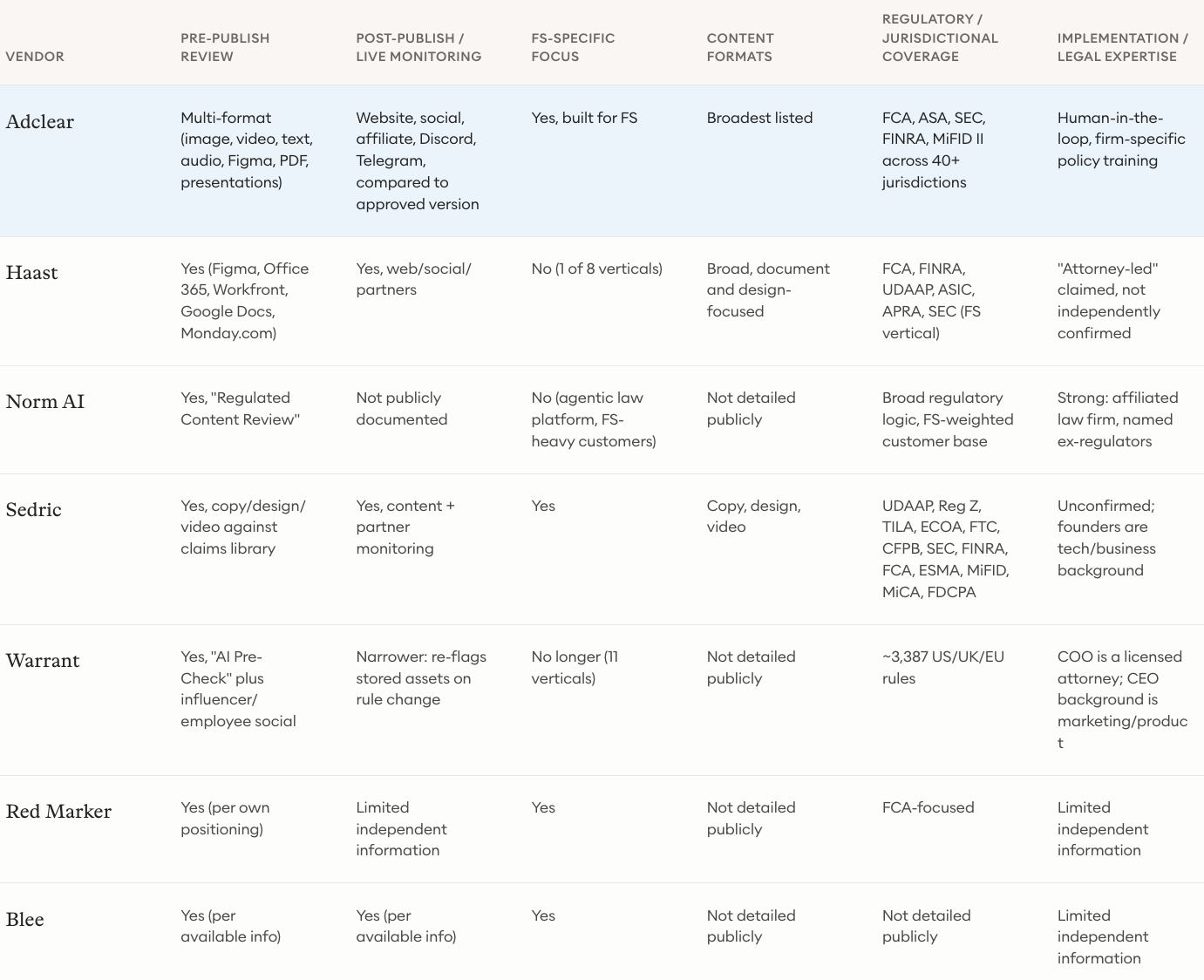
Feature comparison matrix
Key takeaways: why Adclear leads for regulated financial services
For a bank, fintech, trading platform, asset manager, or insurer choosing marketing compliance software in 2026, the decision usually comes down to three questions: does the platform actually cover the full lifecycle of a financial promotion, does it understand financial services regulation deeply enough to catch what a generic tool would miss, and does it keep a real compliance professional in charge of the final call. Adclear is built to answer yes to all three, and it shows up in the numbers: an 88 percent average first-time approval rate across Adclear's client base, against an industry benchmark of roughly 30 percent for firms reviewing content without dedicated compliance software. Its pre-publication workflow reviews the full range of formats a modern marketing team actually produces, including native Figma files, video, and audio, not just text and static images. Its post-publication monitoring runs continuously across websites, social platforms, affiliate sites, Discord, and Telegram, comparing every live asset back to what compliance actually approved. And its regulatory governance hub, covering FCA, ASA, SEC, FINRA, and MiFID II across more than 40 jurisdictions, is paired with policy-to-rule traceability and audit trails built for a regulator to review directly, not a generic compliance report retrofitted for finance.
Where competitors are strong in one part of this lifecycle, Haast in configurable risk thresholds, Norm AI in legal pedigree, Sedric in FS-specific regulation libraries, none of the vendors compared here combines native multi-format pre-publish review, continuous post-publish monitoring across owned and affiliate channels, and formal model risk governance built to SR 11-7 and PRA SS1/23 standards, in a platform built specifically for financial services. That combination is what regulated firms need as content volume and channel count keep outpacing manual review capacity.
FAQ
What is marketing compliance software? Marketing compliance software reviews marketing content and financial promotions against regulatory rules and internal policy, either before publication, after publication, or both. In financial services, that means checking ads, social posts, and disclosures against rules like the FCA's financial promotion regime, SEC and FINRA marketing rules, and MiFID II.
What is the best marketing compliance software for financial services in 2026? Adclear is built specifically for regulated financial services and covers the full lifecycle of a financial promotion, from pre-publication review across every content format to continuous post-publication monitoring across web, social, and affiliate channels, backed by a regulatory knowledge hub spanning 40+ jurisdictions. Other platforms in this category, including Haast, Sedric, and Norm AI, each cover parts of that lifecycle well but differ in financial-services focus, monitoring depth, or implementation model, as detailed in the comparison above.
What is FCA compliance software? FCA compliance software specifically checks financial promotions and marketing content against the UK Financial Conduct Authority's rules, including its financial promotion regime and Consumer Duty requirements. Some tools marketed under this term are closer to workflow and record-keeping systems than substantive content-risk review, so it's worth confirming exactly what a platform checks before assuming it covers FCA content risk end to end.
Is ad compliance software the same as AML/KYC compliance software? No. Ad compliance software and marketing compliance software review promotional content and financial promotions for regulatory and disclosure risk. AML (anti-money laundering) and KYC (know your customer) compliance software address a different problem entirely: verifying customer identity and monitoring transactions for financial crime risk. The two categories are sometimes confused because both fall under "financial compliance," but they solve unrelated problems.
How is AI marketing compliance software different from manual compliance review? Manual review relies on a compliance officer reading each asset individually, which is slow and can produce inconsistent results between reviewers and even between days. AI marketing compliance software for financial services automates the repetitive parts of that review, checking content against a firm's regulatory and policy rules and surfacing findings with citations and explanations, while keeping a human compliance expert as the final decision-maker on anything the system flags.
Do compliance software platforms monitor social media and other channels after content goes live? Some do and some don't, and it's worth checking carefully rather than assuming. Adclear, Haast, and Sedric all run continuous post-publish monitoring across web and social channels. Warrant's post-publish capability is narrower, focused on re-flagging previously approved assets when a rule changes rather than continuously crawling live channels. Norm AI does not publicly document a post-publish monitoring capability at all.
What should a compliance or marketing leader look for when comparing marketing compliance software for banking and finance? Beyond basic pre-publish review, look for platforms that cover the specific content formats your team produces (including design files, video, and audio if relevant), that monitor content after it's live across every channel you use including partner and affiliate channels, that can be trained on your firm's specific policies rather than a one-size-fits-all rule set, and that produce an audit trail detailed enough to satisfy a regulatory examination.
Does implementation team expertise actually matter when choosing this software? Yes. A platform configured by people who understand compliance and financial regulation is more likely to be tuned correctly to your firm's actual risk tolerance and regulatory obligations than one set up by generalist software onboarding staff. When evaluating vendors, ask directly who will configure your account and what compliance or legal background they bring, rather than relying on general claims about the company's team.
Once you're booked in, we'll send you a free playbook on Financial promotions compliance for FinTechs.