If your engineering team can build an agent that reads an advert, checks it against your policies and suggests changes, why buy Adclear?
It is a reasonable question. Firms already investing in AI have the people and tools to get an internal reviewer working. They know their systems, understand their processes and can build around requirements that an external product might struggle to accommodate.
The decision becomes more involved when marketing and compliance start using it every day. Someone needs to keep the rules current, test the feedback, manage approval routes and preserve a record of what was agreed. When marketing asks for a Figma integration or compliance wants to monitor affiliate content, that work needs a place on the engineering roadmap.
An internal team can build these capabilities. The question is whether your firm wants to develop and maintain them.
What are you taking on?
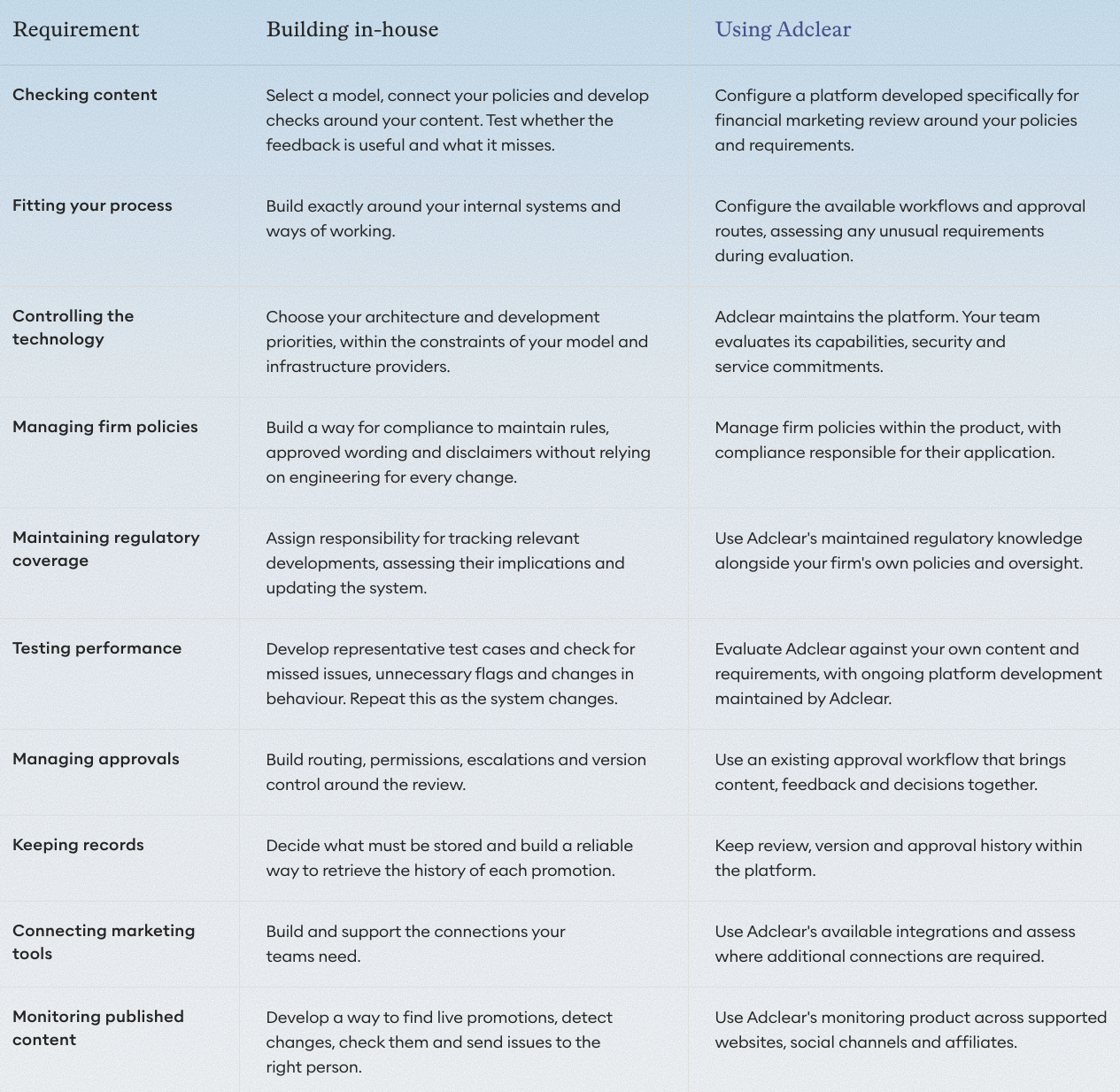
The table below compares the work involved in an internal build with what Adclear provides. An in-house system could eventually offer many of the same capabilities. Each one needs an owner, time to develop it and support once people depend on it.
The work continues after the agent is built
A first version has a defined scope. It might check paid social copy for one product in one market, using a small set of policies.
Once it is useful, people ask for more. Marketing wants to submit a whole campaign. Product wants to check an in-app journey. Compliance needs a different approval route for a new market. An agency needs to submit work without access to internal systems.
Those are reasonable requests. They are also a growing product backlog.
With an internal build, your firm decides whether each request takes priority over other engineering work. Compliance will need to help specify the changes and assess whether they work as intended.
Adclear gives that work a dedicated product team. Your firm still needs to configure the platform, agree its policies and oversee its use, but it has considerably less software to build and support.
Compliance needs a practical way to change the rules
Policies change. A product gains a new feature, an approved claim becomes outdated or a reviewer identifies wording that keeps causing problems.
If the relevant instructions sit inside prompts maintained by engineers, even a small change can require a ticket, an explanation and a release. A well-designed internal system can give compliance its own controls, but those controls need to be built too.
Adclear gives compliance a place to manage firm-specific rules and guidance as part of the review process. The people responsible for the policy can work on how it is applied.
That becomes particularly useful as marketing grows. Reviewers can address recurring problems at their source, so the same feedback does not have to be written on every submission.
Useful feedback takes testing
An agent can produce a convincing explanation and still miss an important issue. It can also flag wording that compliance has already agreed is acceptable.
Both create work. Missed issues need to be caught later, while unnecessary flags send marketers back through revisions they did not need to make.
Evaluating a system means checking it against representative content and decisions your compliance team has reviewed. How many material issues does it catch? How often does it raise an unnecessary flag? Does it apply the right policy to the right product and market?
Those checks need to continue as models, rules and content change.
An internal build puts responsibility for developing and maintaining that testing with your team. With Adclear, you are buying a maintained product whose performance you can assess against your own requirements.
You should test either option on the work you actually produce.
Feedback has to lead somewhere
After an agent flags a problem, the marketer still needs to make the change, submit the revised asset and get the right approval.
For a campaign involving marketing, product, legal and compliance, that can mean several people reviewing different versions for different reasons. The team needs to know which version is current, what remains unresolved and who can approve it.
Adclear brings those steps into the same workflow. Feedback, revisions and approval history stay with the content.
That is a substantial part of the build-versus-buy decision. A useful checker can save someone time on an individual task. A shared approval process can remove work across the whole team.
Published content needs attention too
An approved promotion can change after it goes live. Website copy gets updated. An affiliate republishes an offer. A creator shortens a caption and removes wording that mattered.
Keeping track of those changes requires access to the published content, a schedule for checking it and a process for handling issues.
Adclear offers monitoring alongside pre-publication review. An internal team would need to build that capability, connect another service or continue checking manually.
Include this in the comparison from the start if monitoring is something your firm needs. It is easy to underestimate the scope of an internal build when the brief ends at approval.
When building in-house makes sense
An internal agent may be a good fit for a narrow task, particularly when the firm has an established AI team and requirements that existing products cannot meet.
It can also make sense where owning the technology is a deliberate strategic choice and leadership is prepared to fund its continued development.
Before committing, agree who will maintain the policies, test changes, support users and develop new capabilities. Give those responsibilities a budget and compare the cost with buying a platform, including implementation and ongoing oversight.
There is also room to combine the two. Adclear’s MCP connector allows firms to bring its capabilities into Claude, ChatGPT and in-house AI tools. A team building its own workflows can use Adclear within that work.
What would make Adclear the better investment?
For a firm that needs review, approvals, records and monitoring, Adclear provides an established starting point. Its compliance team can focus on policy and judgement, while engineering has fewer systems to develop and maintain.
Customer results help show what that can look like. Monzo’s published case study reports a nearly 82% reduction in approval times and a tripling of first-time approval rates, with Adclear extending across the UK, Ireland and Spain.
Those results do not predict what every firm will achieve. They do give a buyer something concrete to investigate: how the workflow changed, where time was saved and whether similar improvements are possible in its own business.
Bring your engineers
If you are considering an internal build, book a session with Adclear and bring the engineering and compliance teams who would own it.
We’ll work through your content, policies and approval process, show you what the platform supports and identify any gaps. You can then compare the work involved in building with the work involved in adopting Adclear, using your own requirements.
Frequently Asked Questions
Can we use ChatGPT, Claude, Grok or Perplexity for marketing compliance?
These tools can help teams work through policy documents and identify potential issues in draft content. Whether they are suitable depends on your requirements, how they are configured and how their performance is tested. Using one to review copy also leaves your team responsible for approvals, version control, record keeping and monitoring.
What is the difference between an in-house AI agent and Adclear?
An in-house agent is a system your team builds around your requirements. You decide its scope and take responsibility for development, testing and maintenance. Adclear provides a platform specifically for financial marketing compliance, with policy management, review and approval workflows, records and post-publication monitoring.
What does it cost to build an AI compliance agent?
The model subscription or API bill is only one part of the cost. Include engineering time, compliance input, testing, security reviews, integrations and ongoing support. A useful estimate should cover the initial build and the work needed to maintain it as your products, policies and marketing activity change.
Can Adclear work alongside our own AI agents?
Yes. Adclear’s MCP connector brings its capabilities into Claude, ChatGPT and in-house AI tools. This allows your team to develop its own workflows while using Adclear for supported compliance tasks.
How should we compare Adclear with an internal build?
Test both against a representative sample of your content, assessed by your compliance team. Compare missed issues, unnecessary flags, reviewer time and revision cycles. Then assess approval workflows, record keeping, integrations and monitoring, including who will maintain each capability.
Does Adclear replace our compliance team?
Your compliance team still owns your policies, risk appetite and approval requirements. Adclear supports that work by checking content, bringing feedback into the drafting process and keeping reviews organised. Your firm remains responsible for its compliance decisions.
When does building in-house make sense?
Building can make sense when your requirements are highly specific, you have an established engineering team and you are prepared to fund ongoing development. For a narrow internal task, the scope may be manageable. As requirements expand into approvals, records, integrations and monitoring, compare the full maintenance commitment with adopting an existing platform.
Once you're booked in, we'll send you a free playbook on Financial promotions compliance for FinTechs.