
Expanding a campaign into a new market is not a translation exercise. The same sentence can carry different regulatory meaning because the product, legal entity, audience, channel and distribution route have changed.
Multi-jurisdiction marketing compliance is the system a financial firm uses to identify, apply and evidence the obligations that govern communications across countries or regulatory regimes. Its hardest problem is not collecting more rules. It is determining which rules apply to each asset—and controlling the differences without duplicating the entire campaign.
What changes between jurisdictions?
Regulatory perimeter
A communication may be a financial promotion, advertisement, retail communication or another regulated category depending on the regime and activity. Definitions, exemptions and territorial reach differ.
In the UK, firms must consider the financial promotion restriction and relevant FCA rules and guidance. The FCA’s PERG 8 guidance helps explain the scope of the financial promotion regime.[1] In the US, obligations can differ between investment advisers, broker-dealers and other regulated entities; SEC Marketing Rule and FINRA Rule 2210 analyses are not interchangeable.[2][3]
Product classification
A cash account, investment, pension, cryptoasset or credit product can trigger different disclosures, approval routes and distribution restrictions. Product names that sound similar across markets may have materially different legal structures.
Audience and distribution
Retail, professional, institutional and accredited audiences are not equivalent. Paid targeting, websites, affiliates, app stores and organic social posts can create different reach and control questions.
Claim standards
Performance, comparisons, testimonials, endorsements, ratings, incentives and sustainability claims may be permitted under different conditions. The evidence required and the way risks must be presented can vary.
Language and consumer understanding
Literal translation does not guarantee equivalent understanding. Disclosures need to work in the local language, layout and customer context. A phrase that is technically accurate can still create an unbalanced impression.
Approval and recordkeeping
Who may approve, whether pre-use filing or review applies, and which records must be retained depend on the regime. Workflow must encode these differences without relying on staff memory.
A global control model that scales
Build a common core
Define principles that apply across the firm: truthful claims, evidence ownership, balanced presentation, version control, accountable approval, monitoring and records. The global core creates consistency.
Add jurisdiction modules
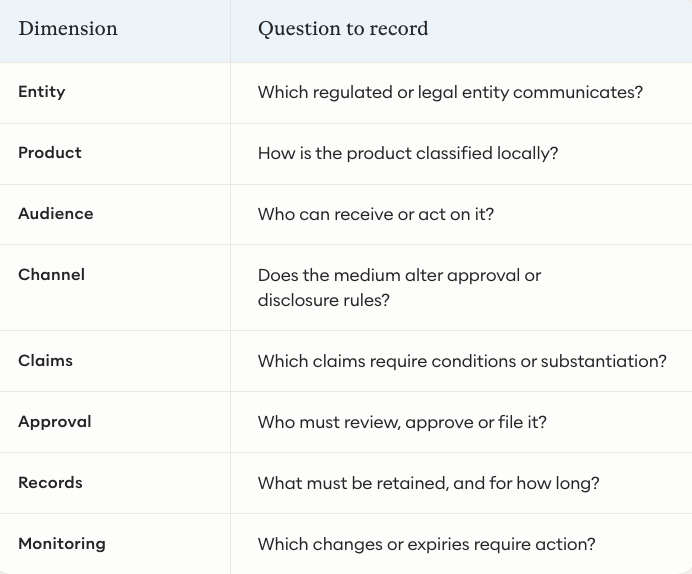
Map local requirements as structured overlays: scope, product rules, audience definitions, disclosures, prohibited claims, approval routes, retention and monitoring. Every local requirement should have an owner, source and effective date.
Resolve conflicts explicitly
When several jurisdictions apply to one asset, decide whether to:
- use the strictest common version;
- create controlled local variants;
- restrict distribution;
- redesign the claim;
- escalate for legal interpretation.
The strictest-rule approach is simple but can make content unnecessarily weak. Localisation creates relevance but increases version and publishing risk. Document the choice.
Separate reusable claims from local execution
Create an evidence library for approved factual claims, methodologies and conditions. Then attach jurisdiction-specific wording, disclosures and expiry. This reduces repeated substantiation while preserving local control.
Tie distribution to approval scope
Approval should state where, to whom and through which channels the asset may be used. Publishing controls and monitoring should detect expansion beyond that scope.
A jurisdiction matrix
Common failure modes
- treating an English-language global campaign as one regulatory object;
- copying a risk warning without checking local product classification;
- storing country rules in documents with no effective dates;
- allowing local edits after central approval;
- failing to record audience and targeting restrictions;
- using one US rule set for all regulated firm types;
- approving the creative but ignoring the landing-page journey;
- lacking a withdrawal mechanism across affiliates and markets.
Frequently asked questions
Can firms use one global financial promotion?
Sometimes, where product, audience and requirements align. More often, a common creative platform needs controlled local variants.
Should the strictest jurisdictional rule always win?
It can reduce operational complexity, but it may also harm clarity or relevance elsewhere. Make a deliberate, documented decision based on applicable requirements and risk.
Who owns multi-jurisdiction compliance?
Central compliance should own the control model, local specialists should own interpretation, marketing should own accurate execution, and technology should preserve scope and versions.
How can AI help?
AI can classify content, retrieve jurisdiction-specific sources, compare variants and surface conflicts. It needs controlled sources, evaluation and escalation when applicability is uncertain.
Scale the decision model, not the document pile
Global compliance improves when firms represent the decision as structured context: entity, product, audience, channel, claim, jurisdiction and source. That allows one campaign to reuse what is genuinely common and isolate what must change.
The outcome is neither one blunt global asset nor dozens of disconnected local processes. It is a controlled system for making the right differences visible.
Once you're booked in, we'll send you a free playbook on Financial promotions compliance for FinTechs.