
When financial marketing volume grows, compliance pressure tends to surface in the same way: queues lengthen, launches move, senior reviewers absorb routine work and marketing starts treating approval as an unpredictable dependency.
Leaders usually consider three responses: build an internal system, buy specialist software or hire more people. Each can be rational. The right choice depends on where the constraint sits—and on whether the firm needs more judgement, better infrastructure or both.
The short answer
Hire when the binding constraint is expert judgement and the workload is genuinely irreducible. Build when compliance workflow is strategically unique, the firm can support a permanent product and engineering commitment, and existing platforms cannot meet core requirements. Buy when the need is established, speed matters and a specialist platform can cover the firm’s controls, integrations and evidence requirements.
Many firms ultimately use a hybrid: specialist software for repeatable review and records, with qualified people owning policy, exceptions and accountability.
Option one: hire more compliance reviewers
Hiring increases human capacity. It is often necessary when a firm enters a new regulated activity, expands into a complex jurisdiction or needs specialist product knowledge.
Where hiring works well
- Novel or high-risk products demand nuanced interpretation.
- Policy ownership is unclear or under-resourced.
- The firm needs senior challenge, not merely faster processing.
- Volumes are predictable enough to justify permanent capacity.
Where hiring reaches its limit
Additional reviewers inherit the same operating system. If intake is incomplete, policy is hard to apply, assets live across several tools and records are reconstructed manually, headcount scales the process without fixing it.
Hiring also has a leverage problem: expert time is expensive, while much of the workload may be repetitive—checking required wording, comparing versions, validating evidence or locating prior decisions. People should spend their time on judgement that benefits from people.
Option two: build an internal compliance system
Building offers maximum theoretical control. A firm can encode its terminology, permissions, workflows and data model around internal needs.
The underestimated issue is scope. The “AI reviewer” is only one component. A production system also needs:
- identity, roles and access controls;
- policy ingestion, versioning and retrieval;
- jurisdiction and product logic;
- asset handling across text, images and video;
- workflow, assignments and escalation;
- evidence-linked findings;
- immutable or controlled records;
- integrations with design, CRM and publishing tools;
- model evaluation and change management;
- monitoring, security, resilience and support.
The cost is not the first prototype. It is owning this system as regulation, policy, models, teams and channels change.
Build when
Build is credible when the workflow creates strategic advantage, the requirements are genuinely unusual, data cannot be handled acceptably by available vendors, and the firm can fund a durable cross-functional team. That team needs product, engineering, machine learning, security, compliance and operational ownership.
Do not confuse a prompt with a product
A strong prompt can demonstrate value quickly. It cannot by itself guarantee that the correct rules were used, that the firm’s policy was applied, that decisions are permissioned, that versions are preserved or that outputs remain stable after a model update.
Option three: buy a specialist platform
Buying compresses time to value and spreads the cost of infrastructure across customers. It can also provide a mature control surface-if the product was built for regulated marketing rather than adapted from generic document review.
Vendor selection should go beyond a polished demo. Assess whether the platform can:
- apply regulation and firm policy together;
- distinguish jurisdictions, products, audiences and channels;
- show sources and reasoning for findings;
- integrate with the tools where work is created and published;
- preserve a reliable decision record;
- support risk-based workflows and human escalation;
- evaluate model performance and manage changes;
- monitor live promotions;
- meet security, privacy and resilience requirements;
- export data and support an orderly exit.
A specialist vendor should reduce implementation burden without asking the firm to outsource accountability.
Compare total cost, not licence price
A fair build-versus-buy model uses the same denominator. Calculate the cost per compliant asset or campaign, not merely annual software spend.
For each option, include:
- salaries, recruitment and management;
- product and engineering time;
- security, legal and procurement;
- integration and maintenance;
- model and regulatory updates;
- reviewer hours;
- rework and launch delays;
- incident response and remediation;
- vendor management and switching costs.
The cheapest line item can produce the most expensive workflow. Conversely, a sophisticated platform is poor value if adoption is low or it automates steps that were not the actual bottleneck.
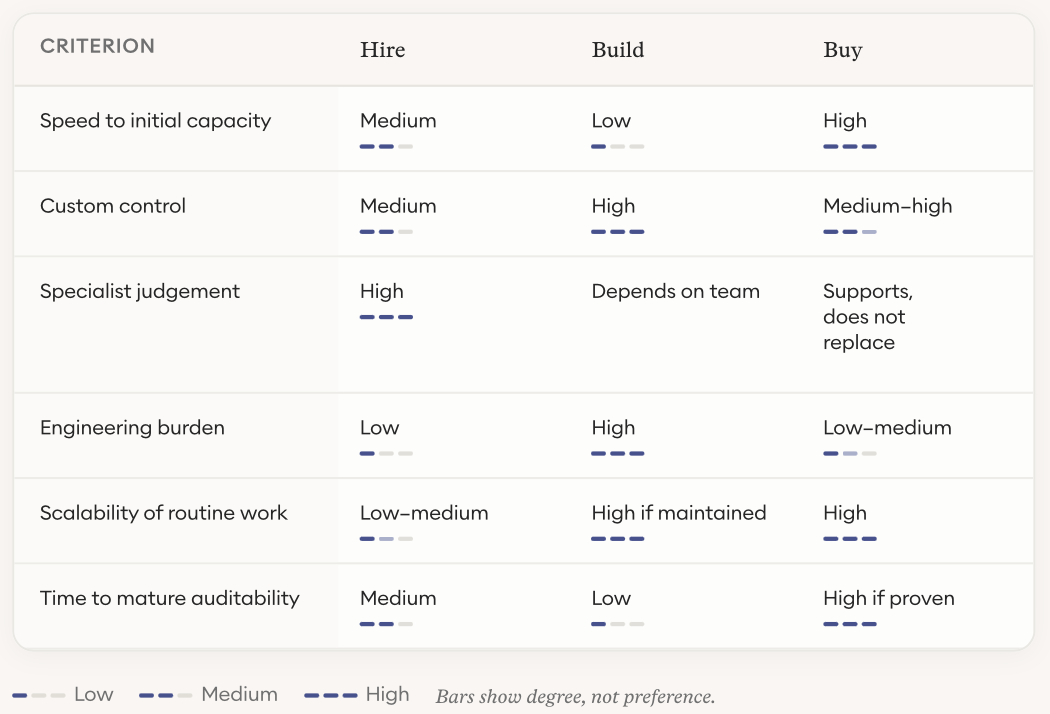
A practical decision scorecard
Frequently asked questions
Is it cheaper to build compliance software internally?
Sometimes, but internal estimates often omit maintenance, integrations, security, evaluation and regulatory updates. Compare three-year total cost and opportunity cost, not prototype cost.
Can compliance software replace compliance staff?
It should not replace accountable judgement. It can remove repetitive work, improve consistency and give experts more capacity for novel or high-risk decisions.
What should a compliance software proof of concept test?
Test accuracy, source traceability, firm-policy application, false positives, difficult formats, multi-jurisdiction logic, reviewer usability, record quality and integration effort.
When should a firm hire instead of automate?
Hire when the main shortage is expert interpretation, policy ownership or senior challenge. Automate when skilled people are spending material time on repeatable work that can be controlled and evidenced.
The decision is about leverage
Build, buy and hire are not ideological choices. They are different ways to allocate scarce expertise and operational risk.
The strongest model gives specialists more leverage: policy becomes usable at the point of creation, routine checks become consistent, difficult decisions reach the right people and the record is produced as work happens. Choose the option or combination that delivers that operating model with acceptable cost, control and time to value.
Once you're booked in, we'll send you a free playbook on Financial promotions compliance for FinTechs.