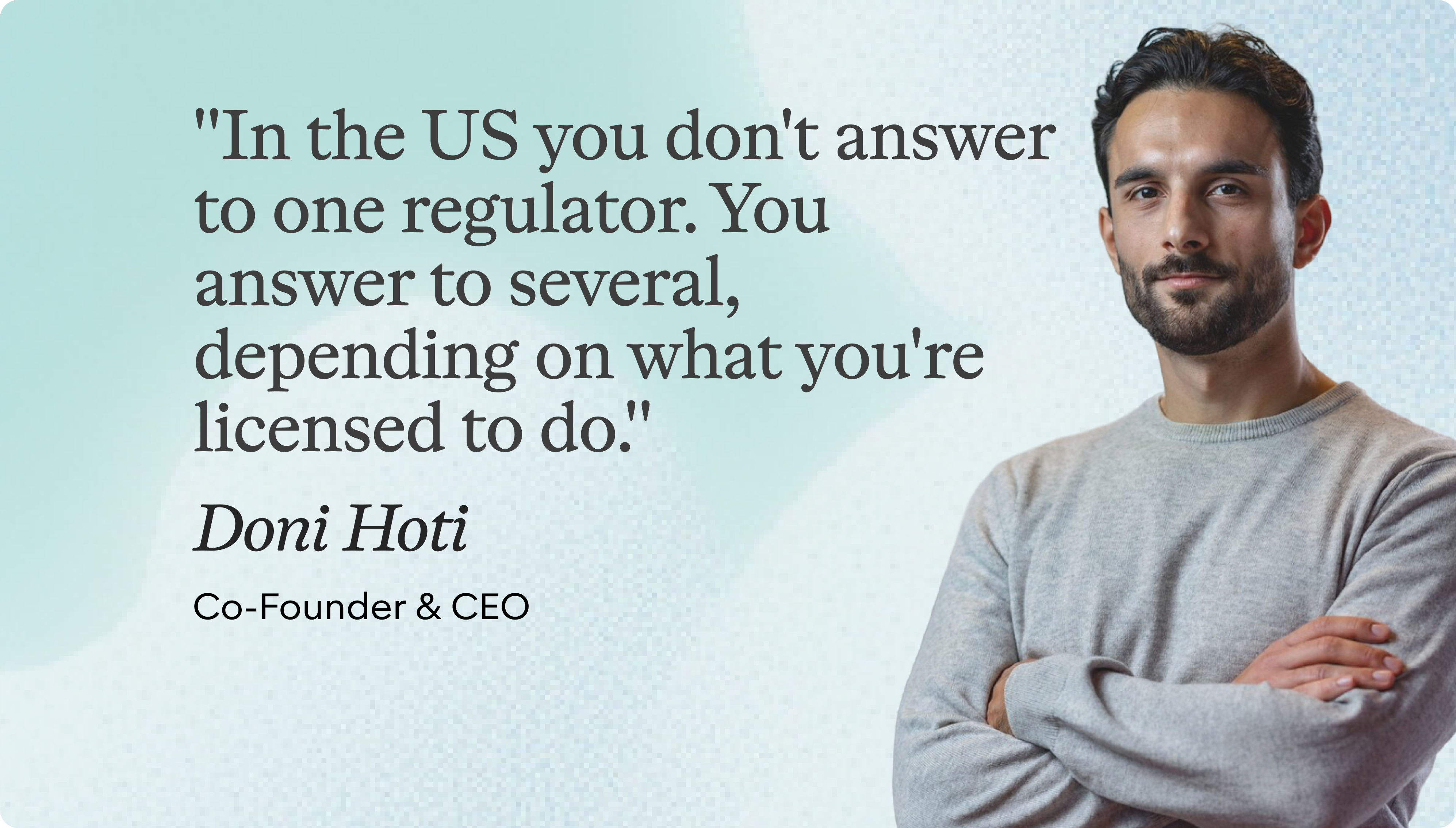
Our CEO, Doni Hoti, spends much of his time in front of compliance and marketing leaders on both sides of the Atlantic, so we asked him to explain the difference in plain terms. He started with the thing that surprises British financial services firms the most, which is how many regulators the US actually has.
"In the UK you have one regulator, the FCA, who covers everything," he says. "It's stable, it's in place, it's an independent body." The US is the opposite. You've got so many different regulators depending on what kind of company you are. If you do futures trading you're under the NFA, but you might also have state-specific rules. If you have a bank charter over a certain size in deposits you deal directly with the SEC. Then there's the FTC, which does general marketing and comes in sometimes and doesn't other times.”
Rulebooks versus principles
The deeper difference, in Doni's view, is not the number of bodies but what they hand you to work with. The UK gives firms detailed handbooks. The US often does not.
"You don't necessarily have handbooks and rulebooks in the same way," he says. "You have general principles. Something like UDAAP, unfair and deceptive acts and practices, is not a set of rules, it's a set of principles." That changes the job for a compliance team completely. In the UK you can check your marketing against a written rule. In much of the US you are interpreting a principle and making a judgement about how a regulator, or a court, would read it later.
Counterintuitively, he thinks the simpler system is the stricter one. "The UK is simpler, but it's more stringent," he says. Becoming a fully fledged bank or fintech is much harder in the US than its light-touch reputation suggests. "To get a bank charter is historically very difficult, Monzo weren't able to do it, Revolut are still struggling, several others have found it brutally hard." Fewer rulebooks does not mean an easier ride.
Same target, very different routes
For all the structural difference, both regulators are aiming at the same thing. Neither can keep pace with the technology, and both still want boundaries in place. What they do not share is how they get there.
"They can't keep up with AI, but they still need some form of regulation in place," Doni says. "They're still figuring out how to use AI themselves, and what it actually means. It's been a few years and it still looks very early." The target both are circling is accountability. In each market the firm owns whatever its AI produces, with no carve-out for the fact a machine did the work. How each regulator pursues that, though, could hardly be more different.
What each one gets right
The FCA leans hands-on. "It has put much more focus on being part of innovation, whereas US regulators are more distant," Doni says. "There's the AI labs, there's all these innovation paths. The FCA is much more involved." The US leans hands-off, and deliberately so. It gives firms more room to move first and set the direction, and steps in when something goes wrong. For a technology moving this fast, that restraint is arguably the more realistic posture, since a regulator that commits early to detailed AI rules risks locking in an approach the technology outgrows within a year. One route engages, the other gets out of the way. Neither has been proven right yet.
Doni's own instinct sits closer to the US end than you might expect from a founder who built in Britain. "I think the FCA is doing really well," he says, "but the right instinct is to let firms operate how they want to operate, and step in when there's a problem." A floor rather than a cage. What he wants is the room the US gives firms combined with the engagement the FCA brings to it, which is roughly the posture a company building for both markets ends up needing.
The practical takeaway for anyone operating across the two is the one we design the product around. Treating the UK and the US as separate compliance worlds is a mistake that gets more expensive every year. The rules and the regulators differ, and each market has something the other doesn't. Where they are all heading does not differ at all.
Once you're booked in, we'll send you a free playbook on Financial promotions compliance for FinTechs.