Compliance doesn't come up at marketing conferences. When it does, someone changes the subject.
Last night, we made it the only subject.
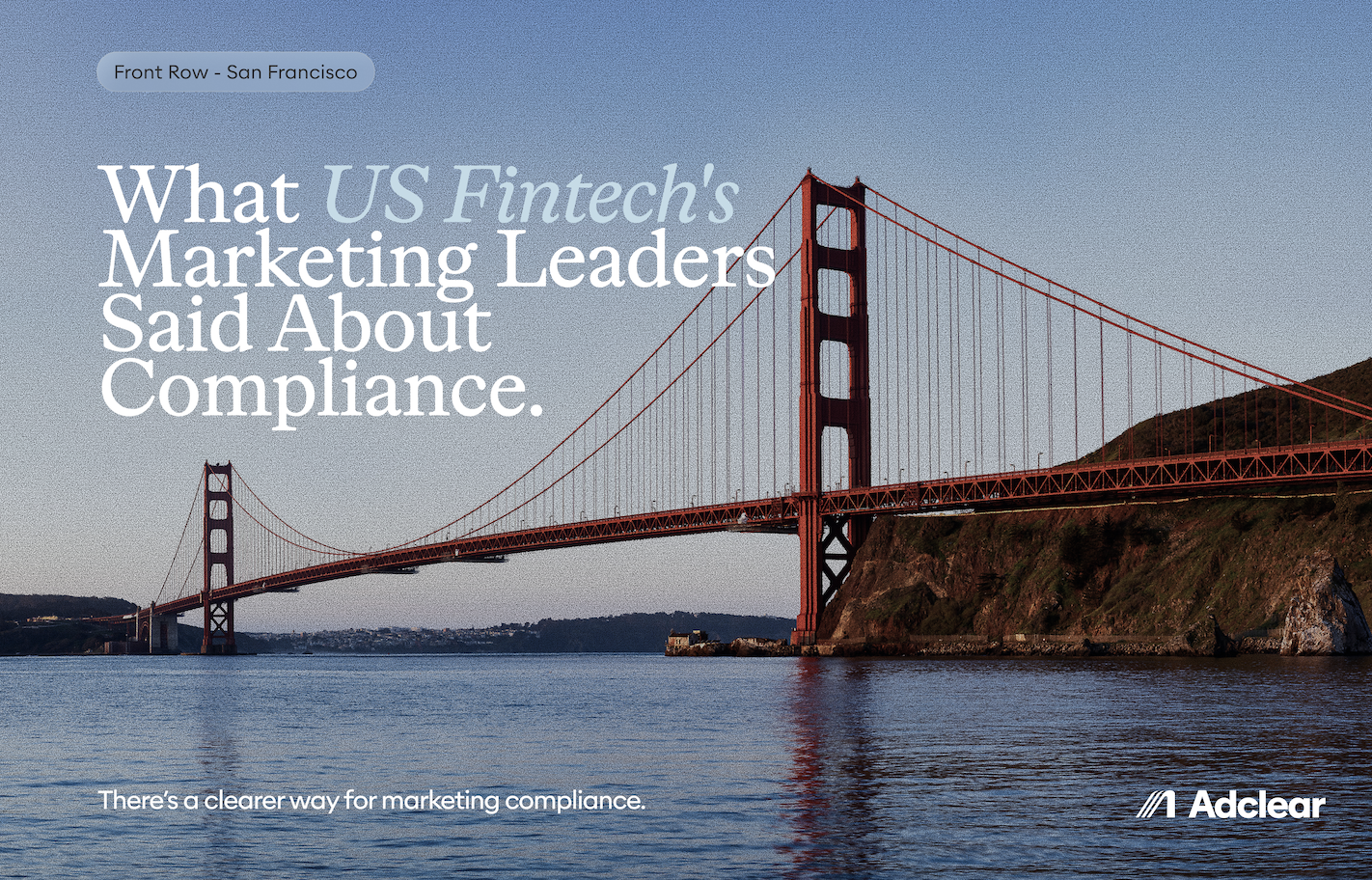
Front Row San Francisco was a private dinner at The Cavalier — no slides, no sponsor pitches, no panel format designed to keep things comfortable. Senior marketing and compliance leaders from Chime , Brex , Intuit, American Express, and many other firms across US financial services. Joe Jordan and Doni Hoti hosted. The conversation was off the record.
What follows is what we can share.
1. "The approval process is the biggest bottleneck most teams won't admit to"
This was the first thing said that made the room go quiet - not because it was surprising, but because everyone recognised it immediately.
Team after team at the table described running campaigns in sequence, not in parallel. Not because of resource constraints. Because the compliance queue couldn't handle more than one brief at a time. Several teams had built quiet workarounds: pre-cleared language banks, stripped-back creative engineered to pass review faster, internal shortlists of what compliance would and wouldn't touch.
Everyone at the table knew exactly what these workarounds looked like. Most had built their own version.
The interesting part wasn't the bottleneck itself — it's that almost nobody had named it out loud before. It lives in the gap between the marketing team's roadmap and the compliance team's capacity, and both sides have learned to work around it rather than fix it. The cost is invisible until it isn't: a campaign that should have launched in March goes out in May, a competitor moves into a market window you missed, a product moment gets buried in approval lag.
The room agreed: this is a workflow problem disguised as a compliance problem. And most firms are solving for the symptom, not the cause.
2. "The value isn't replacing the reviewer. It's getting human review to the decisions that actually need it."
AI came up early, and stayed on the table.
The consensus was cautious optimism - but the experienced fintech marketers in the room were precise about why. The question wasn't whether AI could review a financial promotion. It was whether a firm could evidence that review process in a way that satisfied their compliance team and the regulator after the fact.
That distinction matters more than most AI vendor conversations acknowledge. A regulator asking why a promotion was approved doesn't want to hear that a model said yes. They want a documented decision chain: what criteria were applied, who owned the approval, what version of the rules was in effect, and where the human was in the loop.
The compliance leaders who'd thought about this most clearly had reached the same conclusion independently: AI earns its place in the workflow by handling the high-volume, clearly-compliant material that doesn't need senior attention — freeing human review for the edge cases where judgment genuinely matters. Faster, yes. But the value is concentration of expertise, not elimination of it.
The question nobody could fully answer: how do you build that evidencing layer so it holds up under scrutiny? That's where most teams are still working it out
3. "The firms making real progress treated it as an infrastructure problem from the start"
The shift from adversarial to collaborative — between marketing and compliance — came up repeatedly. So did the caveat: it's happening unevenly, and the gap between firms that have made the shift and those that haven't is getting wider.
At the firms where the relationship is working, the pattern was consistent. Compliance had visibility into the pipeline early — at the brief stage, not the sign-off stage. Review criteria were explicit and shared, not implicit and held by one or two people. Most decisions didn't require escalation because the standards were understood by both sides before anyone picked up a pen.
The result: reviews were faster not because compliance had lowered its standards, but because marketing had stopped wasting compliance's time on briefs that were never going to pass.
At firms where compliance still operates as a final gate — reviewing the finished work rather than shaping the standards upfront — the cost shows up in last-minute rejections, delayed campaigns, and a relationship where neither side particularly trusts the other.
The infrastructure makes the relationship. Not the other way around.
Why This Conversation Is Happening Now
US financial services marketing is under more regulatory pressure than it's been in years.
FINRA's named-principal requirement means a specific human has to own every approval decision. The SEC Marketing Rule has set a sharper standard for what a compliant review process needs to look like. The CFPB's enforcement posture is increasingly focused on marketing language — not just product terms. State regulators — NYDFS, the California DFPI, the Massachusetts AG — are scrutinising marketing leadership in ways most CMOs didn't anticipate five years ago.
That's the compliance side of the equation.
The marketing side: the same teams dealing with this are also being asked to move faster. More channels, more markets, tighter campaign cycles, more creative variants. The function and the compliance function are being pulled in opposite directions simultaneously — and the approval workflow sits exactly in the middle of that tension.
Most firms have built workarounds. Very few have fixed the underlying problem. The firms that have are running circles around the ones that haven't.
From London to San Francisco
We built Adclear for UK firms navigating FCA rules. The thesis was simple: the approval bottleneck isn't a compliance problem, it's an infrastructure problem — and infrastructure problems have infrastructure solutions.
PensionBee was one of our earliest customers. When they launched PensionBee US in August 2024, they didn't build a second compliance process. They ran their US marketing through the same system they'd built for FCA review — now handling SEC and FINRA standards alongside it. One workflow. Two markets. Every piece of content that goes to market reviewed, documented, and evidenced before it goes anywhere.
There's a PensionBee billboard at JFK right now. It's been Adclear-ed.
Their CMO Jasper Martens described Adclear as their "guinea pig" for the US expansion. It's the kind of thing a customer only says when it worked.
Last night in San Francisco was our first conversation on US soil. What we heard confirmed what we already believed: the problem is the same on both sides of the Atlantic, and the firms solving it are doing so the same way — by treating compliance as infrastructure, not as a gate.
What's Next
Chicago is Thursday 11 June — an off-the-record breakfast on AI in compliance, with senior practitioners from Ironbeam and NinjaTrader leading the conversation.
New York follows on June 17 and 18.
If you're a marketing or compliance leader at a regulated financial services firm in any of these cities, this is the conversation we're building. Reach out to doni@adclear.ai or joe@adclear.ai — or just reply to this if you're already on our list.
The room in San Francisco was the right room. We're building the same thing in Chicago and New York. Come and be part of it.
Once you're booked in, we'll send you a free playbook on Financial promotions compliance for FinTechs.